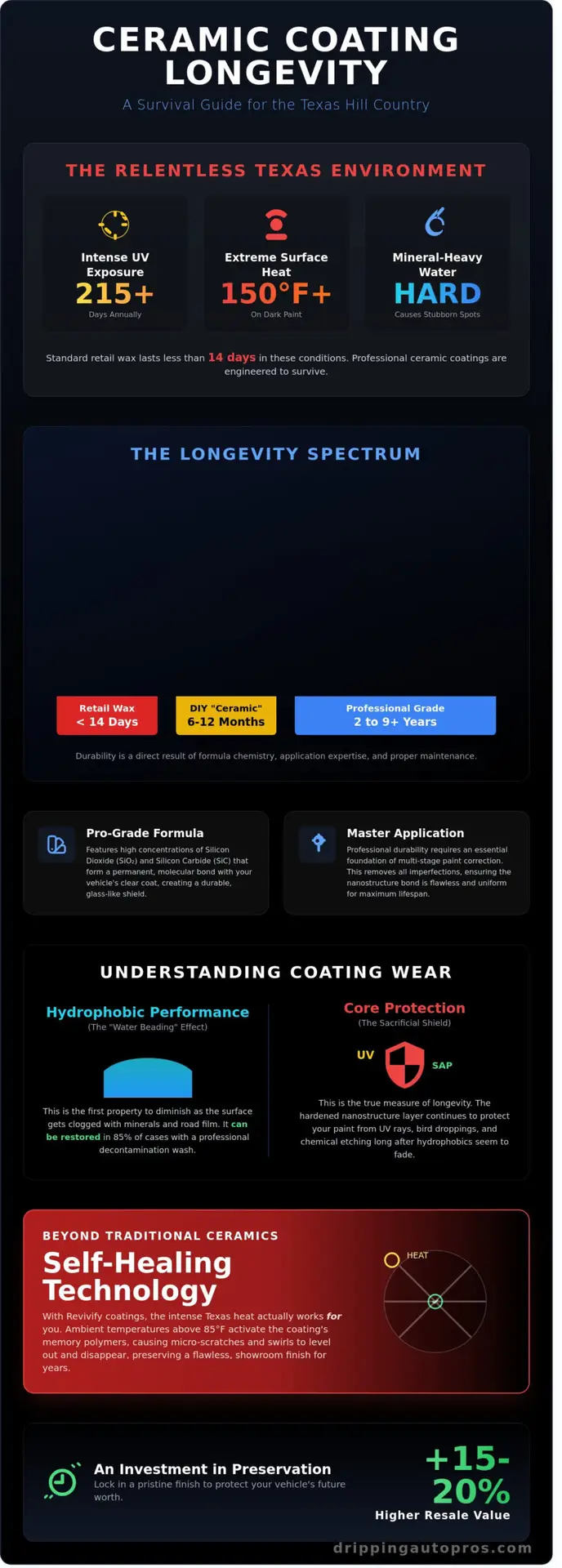
The Texas Hill Country sun delivers over 215 days of intense UV exposure every year, a force that can strip away standard retail wax in less than 14 days. For local enthusiasts, the primary concern isn’t just aesthetics but the functional reality of how long does ceramic coating last when confronted with 105-degree Dripping Springs summers and mineral-heavy well water. You already know that your vehicle is a significant investment that requires more than a simple wash to maintain its showroom floor brilliance. Our team at Dripping Auto Pros views every vehicle as a masterpiece, applying a sophisticated armor that transforms your car’s exterior into a resilient, hydrophobic fortress.
It’s frustrating to watch hard water spots and micro-marring dull a once-flawless finish. This 2026 guide reveals the precise lifespan of professional-grade ceramic coatings in our unique climate and shows you how to protect your automotive investment for the long haul. We will explore the technical factors that influence durability and provide a clear roadmap for maintaining a high-gloss, wet look that persists through every dusty ranch road and summer storm.
Key Takeaways
- Understand the specific environmental variables that determine how long does ceramic coating last in the intense Texas Hill Country climate, ranging from standard durability to elite, decade-long protection.
- Discover how to shield your vehicle’s finish against the brutal UV radiation and extreme surface temperatures unique to Dripping Springs that can compromise lesser products.
- Learn why professional-grade paint correction and high-concentration formulas are the essential foundation for achieving a flawless, long-term nanostructure bond.
- Master the specific maintenance rituals and two-bucket washing techniques required to preserve your coating’s hydrophobic properties and unrivaled gloss for years to come.
- Explore the revolutionary self-healing capabilities of Revivify technology, where Texas heat actually repairs micro-scratches to maintain a pristine, showroom aesthetic.
Understanding Ceramic Coating Longevity: What to Expect in Central Texas
Investing in your vehicle’s appearance in Dripping Springs isn’t just about vanity; it’s about preservation against a relentless climate. A professional ceramic coating acts as a semi-permanent nanostructure bond that fuses with your car’s exterior to create a rigid, glass-like shield. While traditional waxes or sealants might survive a few weeks of our humidity, these advanced coatings provide a durable barrier that doesn’t melt under pressure. Most enthusiasts ask how long does ceramic coating last when they first witness the intense 100-degree days in July. The industry benchmark typically spans from 2 to 9 years, though the specific formula and your maintenance habits ultimately dictate that timeline.
For Austin drivers, it’s vital to distinguish between warranty life and performance life. A 5-year warranty serves as a guarantee against product failure or delamination, but the peak performance of the coating depends on consistent care. This long-term protection is a strategic investment in your vehicle’s resale value. Data from automotive marketplaces suggests that a well-maintained, coated vehicle can command a 15% to 20% premium over neglected counterparts. By locking in a pristine finish, you ensure your car remains a high-value asset rather than just a depreciating machine.
The Science of the Nanostructure Bond
The transformation happens at a molecular level where Silicon Dioxide (SiO2) and Silicon Carbide (SiC) cross-link directly with your vehicle’s factory finish. Modern automobile paint consists of multiple layers that are surprisingly porous and susceptible to rapid oxidation. The coating fills these microscopic valleys to create a permanent sacrificial layer that prevents bird droppings, tree sap, and UV rays from etching the actual paint. This chemical bond is far superior to waxes because it becomes a functional part of the surface rather than a temporary topper.
Performance vs. Protection: What Fades First?
Hydrophobic properties are the first thing owners notice changing over time. When water stops beading and begins to sheet, it doesn’t necessarily mean your protection has vanished. Often, the coating is simply “clogged” with road film, minerals from local hard water, or environmental fallout. In 85% of these cases, a professional decontamination wash can revive those properties and restore the slickness. You’ll know the coating is truly reaching its end when the surface feels rough to the touch and the deep, glossy luster begins to dim across the hood and roof. Understanding how long does ceramic coating last requires recognizing these subtle shifts in surface tension before the base layer fully wears away.
Why the Texas Sun and Hill Country Elements Impact Your Coating’s Lifespan
The Texas sun isn’t just hot; it’s a relentless chemical catalyst. In Dripping Springs, UV radiation levels often reach extreme heights, bombarding your vehicle’s clear coat with high-energy photons that break down standard waxes and consumer-grade sealants in weeks. While aerospace engineers pioneered a process to shield jet engines from thermal degradation, our professional ceramic applications bring that same level of technical heat management to your daily driver. This advanced molecular bonding is the only way to ensure your paint survives the brutal Central Texas climate without losing its depth and luster.
The UV Stress Test in Austin, TX
During an Austin summer, dark paint surfaces frequently exceed 150°F. This extreme heat causes inferior polymers to soften and delaminate, leaving your clear coat vulnerable. When clients ask how long does ceramic coating last in these conditions, the answer depends on the coating’s thermal stability. Professional-grade options like Feynlab Ultra are engineered to maintain their structural integrity at temperatures that would melt traditional protection. This creates a permanent armor, shielding the underlying paint from the oxidation and clear coat failure that claims so many local vehicles. It’s a necessary investment for any car parked outdoors in the Hill Country.
Environmental Contaminants of the Hill Country
The Hill Country presents a unique abrasive gauntlet. Fine limestone dust acts like microscopic sandpaper during dry spells, while sticky cedar pollen creates a bonding agent for acidic contaminants. In the 100-degree heat, bird droppings become highly corrosive; they can etch into unprotected paint in less than 30 minutes. High mineral content in local well water also presents a risk, as rapid evaporation leaves behind calcium deposits that “spot” the finish permanently. Understanding how long does ceramic coating last requires looking at how it resists these specific chemical attacks. A ceramic shield is essential for those commuting between Dripping Springs and Austin, providing a slick, hydrophobic barrier that prevents these elements from finding a foothold. Our specialized coating packages ensure these local hazards don’t compromise your vehicle’s long-term value, keeping the finish pristine regardless of the season.
Professional vs. DIY Coatings: Why Application Quality Dictates Durability
Many owners in Dripping Springs are tempted by the “ceramic in a bottle” promise found at local auto parts stores. While tested consumer products offer a temporary hydrophobic boost, they lack the high-solids concentration found in professional-only formulas. A standard DIY spray might contain 5% to 12% active SiO2, whereas our professional-grade coatings often exceed 80% concentration. This chemical density directly influences how long does ceramic coating last when facing the relentless 100-degree Texas sun. True protection isn’t just about the liquid; it’s about the chemical bond formed during a meticulous multi-stage installation.
The Critical Role of Paint Correction
“A coating is only as durable as the surface it clings to.” Without a Level 2 paint correction, you’re essentially sealing in 100% of the existing swirls, scratches, and oxidation. These microscopic imperfections create air pockets and uneven valleys that prevent the coating from cross-linking with the clear coat. We utilize a two-stage machine polish to remove up to 92% of surface defects, creating a perfectly flat, pristine foundation. This surgical precision ensures the coating doesn’t just sit on top of the car. It becomes a permanent armor that won’t delaminate or fail prematurely due to poor adhesion.
Controlled Environment Application
Texas humidity often spikes above 65%, which causes flash-drying and uneven curing for mobile detailers working in driveways. Our shop-based approach utilizes a climate-controlled bay maintained at a steady 72 degrees. This stability is vital for the first 24 hours of the curing process. We use 1,500-watt short-wave infrared curing lamps to accelerate the molecular bonding. This professional equipment forces the coating to harden from the bottom up. This step is a primary factor in determining how long does ceramic coating last, as it guarantees the shield is fully set before the vehicle ever encounters the Hill Country dust.
The Master Craftsman approach at Dripping Auto Pros treats every vehicle as a masterpiece. We don’t just apply a product; we engineer a defensive barrier. Our process includes a 3-step decontamination wash to remove iron deposits and industrial fallout that DIY kits simply can’t handle. By the time the coating touches the paint, the surface is clinically clean. This level of discipline is what separates a 6-month consumer spray from a multi-year professional investment.
The Master Craftsman’s Guide to Maintaining Your Coating in Dripping Springs
A ceramic coating is a sophisticated shield, but its longevity depends on how you treat the surface. While the Texas sun is a constant adversary, the most immediate threat to your vehicle’s finish is actually the local automatic “brush” car wash. These machines utilize heavy, abrasive bristles that spin at high speeds, trapping grit from the 50 vehicles that entered before yours. This creates a sandpaper effect, inflicting micro-marring and swirl marks that dull the gloss and compromise the Si02 layer. To maximize how long does ceramic coating last, you must commit to a touchless or hand-wash philosophy.
The two-bucket wash method is the gold standard ritual for preserving a pristine finish. One bucket holds your pH-neutral soap solution, while the second contains clean water for rinsing your wash mitt after every panel. This simple separation ensures that dirt removed from the car never returns to the paint. In Dripping Springs, residents often face the challenge of well water, which frequently tests at 15 to 20 grains of hardness. These heavy minerals can bond to your coating, creating stubborn water spots. Using a dedicated water softener or a deionization system is essential to prevent these minerals from etching into your protective armor.
Proper Washing Techniques
Maintain your vehicle using only high-lubricity, pH-neutral soaps designed specifically for ceramic surfaces. When drying, avoid traditional chamois or old towels. Instead, utilize 400 GSM or higher microfiber towels to gently soak up moisture. For the ultimate level of care, we recommend a contactless drying method using filtered, heated air. This eliminates the risk of friction-induced scratches and forces water out of crevices where minerals like to hide. When Texas bugs and road grime accumulate after a drive down Highway 290, use a specialized citrus-based pre-soak to dissolve organic matter before you ever touch the paint.
Professional Decontamination and Toppers
Even with meticulous home care, microscopic iron particles from brake dust and industrial fallout will eventually lodge themselves in the coating’s pores. Every 180 to 365 days, your vehicle requires a professional reset. This process involves chemical decontamination to safely dissolve these particles without abrasive polishing. We then apply a high-silica “topper” or booster that refreshes the hydrophobic properties and adds a sacrificial layer of protection. This professional intervention is the secret to extending how long does ceramic coating last beyond the standard expectations. Our specialists at Dripping Auto Pros treat these maintenance sessions as a technical audit, ensuring your investment remains flawless year after year.
Protect your investment with the precision it deserves. Schedule your professional maintenance detail at Dripping Auto Pros today.
Beyond Traditional Ceramics: How Revivify Self-Healing Technology Redefines Longevity
Revivify represents a paradigm shift in automotive preservation. While traditional ceramic coatings rely on a rigid, glass-like layer to shield your paint, Revivify introduces a flexible, state-of-the-art polymer. This technology doesn’t just resist damage; it actively recovers from it. For enthusiasts asking how long does ceramic coating last, the answer changes when the coating can literally heal itself. In the harsh Central Texas environment, where road debris and abrasive car washes are constant threats, this self-healing capability extends the aesthetic life of the vehicle far beyond standard expectations. It provides a resilient shield that maintains a showroom shine without the need for frequent paint correction.
The Mechanism of Self-Healing
The secret lies in the heat-activated memory of the polymer structure. When surface temperatures reach approximately 120°F to 150°F, the coating softens and flows back into its original, pristine state. On a summer afternoon in Dripping Springs, black paint can easily exceed 160°F within minutes. This intense heat, usually a detriment to standard paint, becomes a restorative tool that clears away micro-scratches and swirl marks. This makes Revivify the ultimate armor for dark-colored vehicles that typically show every imperfection under the Austin sun. By utilizing the climate as a maintenance tool, your vehicle stays flawless longer than with traditional methods.
Choosing the Right Shield for Your Vehicle
Deciding between a traditional powerhouse like Feynlab Ultra and the flexibility of Revivify depends on your specific goals. Feynlab Ultra provides a 5-year warrantied bond with a 9H+ hardness level, offering incredible chemical resistance. However, Revivify solves the longevity problem caused by swirl marks, which often dull the shine of traditional coatings after 24 to 36 months of regular use. Because Revivify heals these marks, the gloss remains deep and uninterrupted for years. Our team evaluates your driving habits and storage conditions to ensure your investment remains flawless. You can contact the experts at Dripping Auto Pros for a personalized protection plan to determine which high-end solution fits your lifestyle. Our master craftsmen treat every vehicle as a masterpiece, ensuring your car leaves our shop with an unrivaled, durable finish that answers the question of how long does ceramic coating last with a standard of excellence that stands the test of time.
Secure Your Vehicle’s Future in the Texas Hill Country
Determining how long does ceramic coating last requires looking past the bottle and focusing on the 100-degree central Texas climate. While consumer-grade sprays might vanish after 12 months, our professional-grade coatings offer 5 to 7 years of resilient protection. This longevity is driven by our meticulous Level 2 paint correction, a process that removes 90% of surface imperfections to ensure a perfect chemical bond between the coating and your clear coat.
As veteran-owned and operated specialists in Dripping Springs, we don’t just apply a product; we install a shield. Our Revivify and Feynlab certifications allow us to utilize self-healing technology that repairs minor scratches with simple heat exposure. We treat every vehicle as a masterpiece, providing an unrivaled barrier against limestone dust and harsh UV rays. Your car’s value is a priority, and our disciplined approach ensures it remains in pristine condition for the long haul.
Protect your investment: Get a custom coating quote from Dripping Auto Pros today
We’re ready to help you achieve the ultimate finish for your vehicle.
Frequently Asked Questions
Does ceramic coating prevent all scratches and rock chips?
Ceramic coating doesn’t prevent rock chips or deep scratches. While it provides a 9H hardness layer that resists light swirling from 85% of improper washing techniques, it lacks the 8mil thickness required to stop high-velocity road debris. For physical impact protection, we recommend layering our coatings over Paint Protection Film to create a total armor system.
How many years can I realistically expect a coating to last in the Austin heat?
When asking how long does ceramic coating last in the Austin heat, you can realistically expect a professional grade coating to endure 3 to 9 years. Our high-solids formulas are specifically engineered to withstand 105 degree temperatures and 100% UV exposure common during our 4 month Texas summers. This durability ensures your clear coat remains shielded even when asphalt temperatures reach 150 degrees.
Can I take my ceramic-coated car through a touchless car wash?
You can take your vehicle through a touchless car wash, but it’s not the ideal maintenance strategy for long-term gloss. These facilities often use high-alkaline detergents with a pH level of 12 to 14 to strip dirt without brushes. These harsh chemicals can degrade the hydrophobic top layer of your coating 40% faster than a standard pH-neutral hand wash every 14 days.
What happens to the car’s paint when the ceramic coating eventually wears off?
Your car’s paint won’t peel or flake when the ceramic coating eventually wears off. Instead, you’ll notice a gradual decline in water beading performance, where water begins to sheet flat across the panels rather than rolling off at a 110-degree angle. Once the coating is gone, your factory clear coat is 100% exposed to environmental acids and UV damage again.
Is ceramic coating worth it for a car that is parked outside in Dripping Springs?
Ceramic coating is an essential investment for any vehicle parked outdoors in Dripping Springs to combat our 2,500 hours of annual Texas sunlight. Without this protection, the sun’s UV rays can cause visible paint oxidation within 36 months. Our professional applications act as a permanent sunblock, maintaining a 95% gloss retention rate even for vehicles without the luxury of a garage.
This same principle of protecting against sun-induced oxidation applies to your home. The intense UV exposure in Texas can degrade exterior paint, making professional application a crucial part of home maintenance. To learn more about protecting your home’s exterior, visit Higher Impact Painting.
How can I tell if my ceramic coating is still working?
Monitoring how water reacts is the best way to determine how long does ceramic coating last on your specific vehicle. If water forms tight, uniform beads that fly off the hood at 35 mph, the bond is strong. If the water sheets or clings to the paint in large patches, the coating’s surface energy has likely been compromised by road film or reached the end of its life cycle.
Do I ever need to wax my car again after it has been ceramic coated?
You’ll never need to wax your car again once it’s been ceramic coated. Traditional carnauba waxes have a low melting point and actually attract more dust to the surface, which masks the 9H ceramic shield. To maintain the finish, we recommend a ceramic-infused silica spray every 6 to 12 months to refresh the hydrophobic properties without compromising the bond.
Why does professional ceramic coating cost so much more than DIY kits?
Professional ceramic coating costs more because it includes 20 to 30 hours of meticulous paint correction to remove 99% of surface defects before sealing. Our professional-grade formulas contain up to 90% SiO2 solids. Consumer DIY kits typically hover around 10% to 15% concentration. This higher chemical density explains why a professional application lasts 5 years while a DIY bottle often fails within 180 days. For those searching for professional car ceramic coating near me, our comprehensive protection guide details the technical advantages of master craftsman application over consumer alternatives.