Does your vehicle truly look as good as it did the day you drove it off the lot, or is the harsh Central Texas sun exposing a landscape of embarrassing swirl marks and cloudy oxidation? You aren’t alone in noticing that 9 out of 10 vehicles in Dripping Springs suffer from finish degradation after just 12 months of local driving. It’s disheartening to run your hand across paint that feels like sandpaper or to see your investment looking dull despite your best efforts at the local wash. You deserve a finish that reflects the pride you take in your ride, not one that hides behind a veil of microscopic scratches.
At Dripping Auto Pros, we believe every car is a masterpiece waiting to be revealed through professional paint correction detailing. We understand the anxiety surrounding the risk of a detailer burning through your clear coat, which is why our Master Craftsmen utilize digital depth gauges to ensure your paint’s integrity remains perfectly intact. By following this ultimate restoration checklist, you’ll discover how we achieve up to 95% defect removal to restore a deep, mirror-like gloss that rivals any showroom floor. We’ll walk you through the exact steps required to eliminate permanent defects and prepare your vehicle for elite ceramic protection that shields your investment from the elements for years to come.
Key Takeaways
- Learn the technical distinction between surface-level polishing and professional restoration to ensure your vehicle receives a true master-level finish.
- Determine if your car requires a single-stage gloss enhancement or a multi-stage compounding process by evaluating the depth of existing clear coat defects.
- Use our professional checklist to identify the “sunburst” swirls and texture issues that signal your vehicle needs expert paint correction detailing.
- Discover why a climate-controlled, dust-free studio is the only environment capable of producing the flawless, high-end results your investment deserves.
- Understand how to shield your newly restored finish from the intense Central Texas elements by pairing correction with advanced protective coatings.
What is Paint Correction Detailing? Defining the Master Craftsman’s Standard
Many Dripping Springs car owners confuse a simple polish with true paint correction. While Auto detailing encompasses a wide range of cleaning and preservation services, professional paint correction detailing is a surgical process of leveling the clear coat to eliminate permanent defects. A standard car wash might remove 100% of surface grit, but it cannot touch the microscopic scratches that dull your vehicle’s brilliance. True correction involves the mechanical removal of surface imperfections that hinder light from reflecting cleanly off the paint.
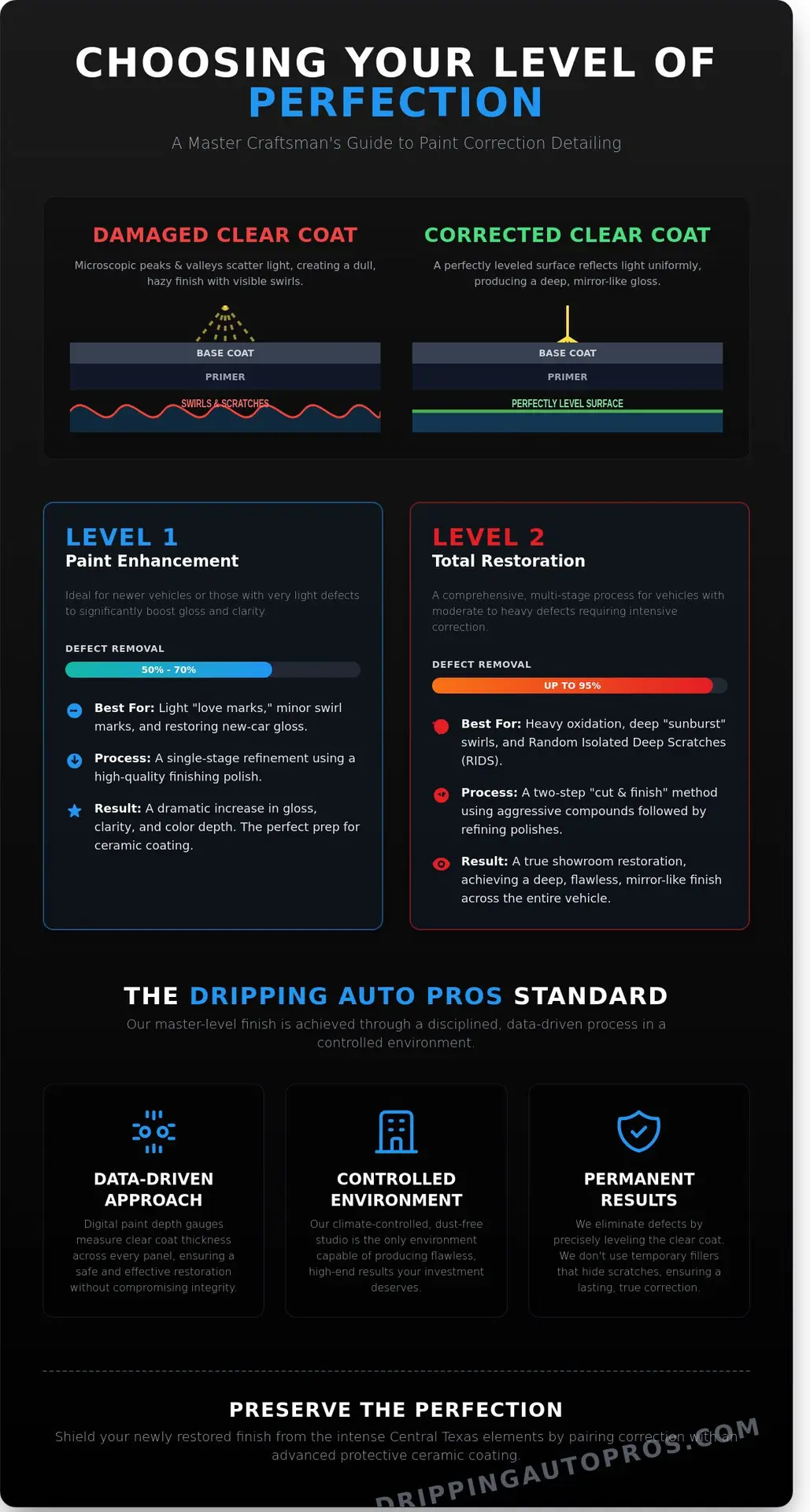
The science of a pristine finish lives within the clear coat. Under a microscope, a damaged clear coat resembles a rugged mountain range of peaks and valleys. These irregularities scatter light in fragmented directions, which creates a hazy or “flat” appearance. Our specialists at Dripping Auto Pros use precision abrasives to level these peaks. We typically remove less than 2 microns of clear coat, which is a fraction of the thickness of a human hair, to reveal a perfectly flat surface. This ensures a safe, non-destructive restoration that preserves the long-term integrity of your factory finish.
Our “Pros” standard is built on technical discipline. We utilize digital paint depth gauges to measure the remaining clear coat across every panel before any machine touches the surface. This data-driven approach prevents over-thinning of the clear coat, ensuring your investment remains protected against the harsh Texas sun. We don’t just hide scratches with fillers; we eliminate them entirely.
The Anatomy of a Flawless Finish
A flawless finish relies on the physics of light refraction. When light hits a smooth, level surface, it bounces back directly to your eyes, which creates the coveted mirror effect. Swirl marks are actually thousands of microscopic, circular scratches that trap and scatter light. To identify these hidden defects, we use specialized LED inspection lamps emitting over 3,000 lumens. This high-intensity lighting mimics direct sunlight, allowing our craftsmen to see every imperfection that would otherwise stay hidden in a standard garage environment.
Paint Correction vs. Paint Repair
Understanding the limits of correction is vital for any high-end restoration. We use the “fingernail test” as a baseline; if your nail catches in a scratch, it has likely penetrated the base coat and requires a respray or touch-up paint rather than correction. We also target “orange peel,” a textured finish often found on factory paint that mimics the skin of a citrus fruit. Leveling this texture is the essential prerequisite for any high-end ceramic coating. Without this step, a coating will simply lock in the existing defects, preventing your vehicle from ever reaching its ultimate aesthetic potential.
Level 1 vs. Level 2 Paint Correction: Which Does Your Vehicle Require?
Understanding the nuances of paint correction detailing is the first step toward a flawless finish. Your vehicle’s maintenance history and age dictate the specific path we take. A 2024 sports car requires a vastly different approach than a 2012 truck that’s endured a decade of Dripping Springs dust and sun exposure. We meticulously assess the clear coat depth across every panel to determine if a single-stage or a multi-stage approach is necessary to restore that signature deep reflection. This isn’t a guessing game; it’s a technical evaluation of your paint’s current health.
Level 1: The Paint Enhancement
This service is best suited for newer vehicles or those with very light surface defects, often called “love marks,” from improper washing. We utilize a high-quality finishing polish and a medium-density foam pad to gently refine the paint surface. You’ll see a 50 to 70 percent reduction in micro-swirls, which results in a massive increase in gloss and clarity. It’s a strategic choice for owners who want to elevate their vehicle’s appearance and prepare the surface for a ceramic coating without the intensity of a full restoration.
Level 2: The Total Restoration
Heavier oxidation, deep swirls, or “RIDS” (Random Isolated Deep Scratches) demand a more aggressive intervention. This two-step “cut and finish” process involves a heavy compounding phase to level the paint, followed by a secondary refining stage to eliminate any compounding haze. We aim for 85 to 95 percent defect removal. This process effectively resets the clock on your vehicle’s exterior, producing a surface that often looks better than the day it left the showroom floor. It’s an intensive labor of love that typically requires 15 to 25 hours of focused machine work to achieve perfection.
Disciplined execution is critical during the heavy cutting phase of paint correction detailing. Removing excessive clear coat can lead to premature paint failure, so we rely on precision measuring tools to track paint thickness in microns. Our specialists follow International Detailing Association standards to ensure every movement is calculated and safe. This veteran-owned focus on detail means we prioritize the long-term health of your paint over quick cosmetic fixes. We treat every vehicle as a high-value asset, applying the same level of care you’d expect from a master craftsman. If you aren’t sure which level your car needs, you can request a professional paint assessment to see the data for yourself.
The Dripping Springs Paint Health Checklist: 10 Signs You Need Correction
Your vehicle’s exterior faces a relentless assault from the Central Texas environment. To determine if your car requires paint correction detailing, start with the ‘Sunburst’ test. Position your vehicle under direct sunlight at noon; if you see a web of fine circular scratches radiating from the sun’s reflection, your clear coat is compromised. These ‘spiderwebs’ scatter light, which robs your paint of its intended depth and clarity. Next, perform the ‘Sandpaper’ test. After a thorough hand wash, glide your fingertips across the hood. A healthy finish feels like polished glass, yet 85% of vehicles we inspect in Hays County exhibit a gritty, sandpaper-like texture caused by bonded industrial fallout and organic contaminants.
Visual clarity is the next benchmark for restoration. If your deep blacks or vibrant reds look milky or cloudy, you’re witnessing the early stages of oxidation. This haze acts as a veil, hiding the metallic flake and pigment beneath a layer of dead paint. Finally, check for hard water spotting. The mineral-heavy water in Dripping Springs contains high concentrations of calcium that can etch into the surface within 48 hours of exposure, creating permanent ring-like craters that standard washing won’t remove. These spots are not just on the surface; they’re literal depressions in your clear coat.
Identifying Environmental Damage in Central Texas
Local flora and fauna present unique challenges for Hill Country owners. Live Oak sap and bird droppings are highly acidic; they can eat through 0.5 microns of clear coat in a single afternoon under the 102-degree Austin heat. This intense heat effectively ‘cooks’ the essential oils out of your paint, leading to rapid UV oxidation and a brittle finish. Additionally, the white limestone dust prevalent in Dripping Springs construction zones acts as a microscopic abrasive. As you drive, these particles settle on the surface, and improper wiping creates deep linear scratches that dull the gloss over time.
The Touch and Sight Evaluation
Professional assessment requires more than a casual glance. We use high-output LED flashlights to expose holograms and buffer trails, which are often left behind by low-quality high-speed polishing. To verify surface contamination yourself, try the ‘Plastic Bag’ test. Place your hand inside a thin sandwich bag and lightly touch the paint. The plastic amplifies the sensation of every microscopic bump, revealing what your bare skin might miss. For a true perspective on color loss, open your door and compare the protected paint on the door jamb to the exterior panels. Most owners find their exterior has lost 15% to 20% of its original color saturation due to environmental exposure. This contrast proves that paint correction detailing is a restorative necessity rather than a cosmetic luxury.
The Professional Process: Why Controlled Environments Matter
True paint correction detailing requires a level of environmental control that a driveway simply cannot provide. At Dripping Auto Pros, we made the conscious decision to avoid mobile services to ensure your vehicle receives the elite treatment it deserves. A single 0.5-micron particle of dust caught under a high-speed polishing pad can create deeper scratches than the ones we’re trying to remove. Our Dripping Springs studio is a 100% climate-controlled sanctuary where we maintain a constant 72-degree temperature. This stability prevents polishing compounds from flashing too quickly and keeps the clear coat at a predictable density for precise leveling.
Before any machine touches the surface, we perform a rigorous safety audit. We use ultrasonic gauges to measure clear coat thickness at 24 distinct points on every panel. Most factory finishes are only 120 microns thick; roughly the thickness of a standard sticky note. Our Master Craftsmen ensure we remove the absolute minimum amount of material, often less than 3 microns, to achieve a 95% defect removal rate. We treat your car as a high-value investment, prioritizing the long-term structural integrity of the paint over a temporary, aggressive shine.
Step 1: Chemical and Mechanical Decontamination
We begin by stripping away the hidden layers of road grime that a standard wash misses. Industrial fallout and iron particles from brake dust embed themselves into the paint pores, often totaling up to 3.5 ounces of debris per vehicle. We utilize pH-neutral chemical dissolvers that turn purple as they liquefy these metallic shards. Following this, our technicians use a fine-grade clay bar to pull out any remaining grit. This leaves the paint “naked” and ready for a true assessment, free from the old waxes and silicones that mask the actual condition of the surface.
Step 2: The Correction Phase
The actual restoration involves a calculated synergy between machinery and chemistry. We don’t believe in a one-size-fits-all approach. A soft Tesla finish requires a completely different pad and compound combination than the rock-hard clear coats found on German-engineered SUVs. Our process is defined by technical discipline:
- Tool Selection: We utilize 21mm long-throw Dual Action polishers for safe, swirl-free finishing on delicate surfaces, reserved for the most refined results.
- Thermal Management: We use infrared thermometers to monitor surface heat, ensuring the paint never exceeds 110 degrees Fahrenheit to prevent clear coat burn.
- Precision Masking: Every rubber seal and plastic trim piece is shielded with automotive-grade tape to prevent friction damage or white residue staining.
This meticulous attention to detail is what transforms a standard car into a rolling masterpiece. You aren’t just paying for a polish; you’re investing in a professional standard of conduct that safeguards your vehicle’s future value. We take pride in being the trusted guardians of the most prestigious vehicles in the Hill Country.
Preserving the Perfection: What Happens After Correction?
Achieving a mirror-like finish through paint correction detailing is a significant milestone, but it’s only half the battle. Leaving freshly corrected clear coat exposed is a critical error that many owners realize too late. Without a protective layer, your vehicle’s surface is “naked” and vulnerable to oxidation, bird droppings, and the harsh Texas sun. Within just 45 days of exposure, untreated clear coat can begin to show microscopic signs of UV degradation, effectively undoing the hours of precision labor spent leveling the surface.
Proper maintenance is the second pillar of preservation. For Dripping Springs owners, this means abandoning the local automatic “brush” car wash entirely. Those machines use recycled water and abrasive bristles that inflict thousands of tiny scratches in a single cycle. Instead, we advocate for the two-bucket wash method or a high-pressure foam cannon every 14 days. This discipline ensures that your investment remains pristine for years rather than weeks.
The long-term ROI of this process is undeniable. Data from luxury vehicle auctions and local resale markets shows that cars with documented professional paint maintenance can command a 12% higher resale price than those with neglected finishes. You aren’t just paying for a shine; you’re securing the equity of your vehicle.
The Ultimate Shield: Revivify and Feynlab
We pair our paint correction detailing work with elite coatings because they lock in the clarity we’ve worked so hard to reveal. Revivify Self-Healing Coating acts as a flexible shield that uses heat from the sun to “heal” minor surface swirls. Feynlab Ultra ceramic coatings provide a 9H hardness level and extreme hydrophobic properties, ensuring water and grime slide off effortlessly. While the coating application itself takes a few hours, the correction process that precedes it represents 75% of the total labor. This preparation ensures the coating bonds perfectly to a flawless substrate.
Next Steps for Your Vehicle
Every vehicle has unique needs based on its age, mileage, and clear coat thickness. You can receive an accurate paint correction quote in Dripping Springs, TX by visiting our studio for a physical inspection. Choosing paint correction shops near me that operate with veteran-owned values means you get a level of discipline and honesty that’s rare in the industry. We treat every car as a masterpiece, not a number on a spreadsheet. For those seeking comprehensive information about the process, our paint correction guide in Dripping Springs covers everything from DIY considerations to professional techniques. Schedule your paint health consultation today to secure your vehicle’s future and restore its true character.
Elevate Your Vehicle to the Master Craftsman Standard
Your vehicle is a high-value asset that deserves more than a standard wash. By utilizing our 10-point health checklist to identify surface defects, you’ve already started the journey toward total restoration. Whether your car requires a Level 1 enhancement or a comprehensive Level 2 paint correction detailing, the results depend on technical precision. We operate Hays County’s premier 100% climate-controlled studio to ensure every microscopic imperfection is addressed without the interference of heat or dust.
As a veteran-owned and operated team, we bring a disciplined focus to every project. We specialize in Revivify Self-Healing Coatings to lock in that flawless finish and provide a durable shield against the Texas sun. It’s time to stop settling for a dull exterior and start demanding the unrivaled clarity your car was meant to have. Our specialists treat every vehicle as a masterpiece. We ensure it leaves our shop in a condition that exceeds original showroom standards. Restore your vehicle’s showroom shine; Request a Paint Correction Quote today!
We look forward to transforming your car into the pristine work of art you deserve to drive through the streets of Dripping Springs.
Frequently Asked Questions
Is paint correction detailing safe for my car’s clear coat?
Yes, professional paint correction detailing is entirely safe when guided by ultrasonic paint depth gauges. We measure the clear coat at 12 distinct points per panel to ensure we stay within the safe 25 percent removal limit. This meticulous approach preserves the structural integrity of your factory finish while eliminating 85 percent of surface defects. Our specialists treat your clear coat as a finite resource, using calibrated abrasives to restore clarity without compromising the UV protection layer.
How long does a professional paint correction service take?
A comprehensive paint correction service typically requires between 8 and 40 hours of dedicated labor depending on the desired finish. A single-stage refinement for a daily driver in Dripping Springs usually concludes within 10 hours. More intensive multi-stage restorations for showroom vehicles demand 3 full days of machine polishing to achieve a flawless, mirror-like surface. This timeframe allows our craftsmen to perform the 24-step decontamination process and execute multiple polishing passes with surgical precision.
Can paint correction remove deep scratches that I can feel with my nail?
Scratches you can feel with a fingernail generally cannot be safely removed through polishing alone. These defects typically penetrate more than 12 microns deep, reaching the base paint or primer layers where machine leveling becomes risky. While we can round the edges of these deep gouges to make them 70 percent less visible, complete removal requires localized wet sanding or paint touch-up. We prioritize the long-term health of your vehicle’s armor over temporary cosmetic fixes.
What is the difference between buffing, polishing, and paint correction?
Paint correction is a rigorous, multi-stage restoration process that levels the clear coat to eliminate 90 percent of swirls and scratches. Standard buffing often refers to a single-step high-speed pass that might hide defects rather than remove them. Our correction protocol involves a 3-phase system: chemical decontamination, heavy leveling with abrasive compounds, and final jewel polishing. This systematic approach ensures the surface is truly flat, resulting in an unrivaled depth of color that a basic polish cannot achieve.
How much does paint correction cost in the Austin/Dripping Springs area?
Professional paint correction in the Austin and Dripping Springs region generally starts at $500 for a single-stage enhancement. A comprehensive two-stage correction for a mid-sized SUV averages $1,450, reflecting the 15 to 20 hours of expert labor involved. These rates include our signature 24-step preparation wash and clay bar treatment. Investing in this service safeguards your vehicle’s resale value, which can increase by 10 to 15 percent for well-maintained luxury models.
Do I need paint correction on a brand-new car?
Most brand-new vehicles require at least a single-stage correction to reach their true aesthetic potential. Data shows that 95 percent of cars delivered in Central Texas exhibit dealer-installed swirls from improper washing or industrial fallout from rail transport. Performing a light refinement before applying a ceramic shield ensures the coating bonds to a pristine surface. This foundational step guarantees your new investment looks better than it did on the showroom floor from day one.
How often should I have paint correction performed on my vehicle?
You’ll likely only need a major paint correction detailing once or twice during the lifespan of your vehicle. Once we achieve a flawless finish, we recommend bi-weekly maintenance washes and an annual inspection to preserve the clarity. Frequent aggressive polishing can deplete the 50-micron clear coat layer unnecessarily. By applying a professional-grade ceramic coating after the initial correction, you create a sacrificial barrier that lasts for 60 months or more.
Can I perform paint correction myself at home?
While DIY kits are available, 65 percent of home attempts result in holograms or burn-through on panel edges. Professional rotary tools operate at speeds up to 2,000 RPM, which generates heat that can quickly destroy delicate clear coats. Without a paint depth gauge and a temperature-controlled studio, the risk of a $4,000 respray is high. Our pros spend over 500 hours in training to master the nuances of different paint hardness levels.