A single percentage point of light transmission is often the thin line between a sophisticated, street-legal aesthetic and a failed state inspection for legal tint in texas. In Dripping Springs, where the 100-degree summer sun acts as a constant threat to your vehicle’s interior, the desire for privacy can easily lead to costly compliance errors. You likely already understand that maintaining a cool cabin is essential for preserving high-value leather and trim from UV degradation. It’s frustrating to face the confusion of VLT percentages while trying to shield your car from the Central Texas glare.
This guide empowers you to master the 2026 regulations, ensuring your vehicle remains a masterpiece of both form and function. We will examine the mandatory 25% VLT standards for side windows, the specific technicalities of windshield brow limits, and the specialized ceramic technologies that offer unrivaled heat rejection without crossing legal boundaries. By the end, you’ll have a clear roadmap to protect your investment while staying fully compliant with state law.
Key Takeaways
- Master the core 25% VLT regulations for legal tint in texas to ensure your vehicle remains street-legal while maintaining a sophisticated, high-end aesthetic.
- Identify the critical placement of the AS-1 line on your windshield to avoid common compliance errors that lead to failed inspections and unnecessary fines.
- Navigate the specific differences between front and rear window allowances, allowing you to maximize privacy and heat protection without compromising safety standards.
- Understand the “fix-it” ticket process and how Dripping Springs law enforcement utilizes technical tools to measure transparency during routine stops.
- Discover why elite heat rejection relies on advanced IR and UV technology rather than darkness alone, providing a pristine shield for your vehicle’s interior.
Understanding Texas Window Tint Standards in 2026
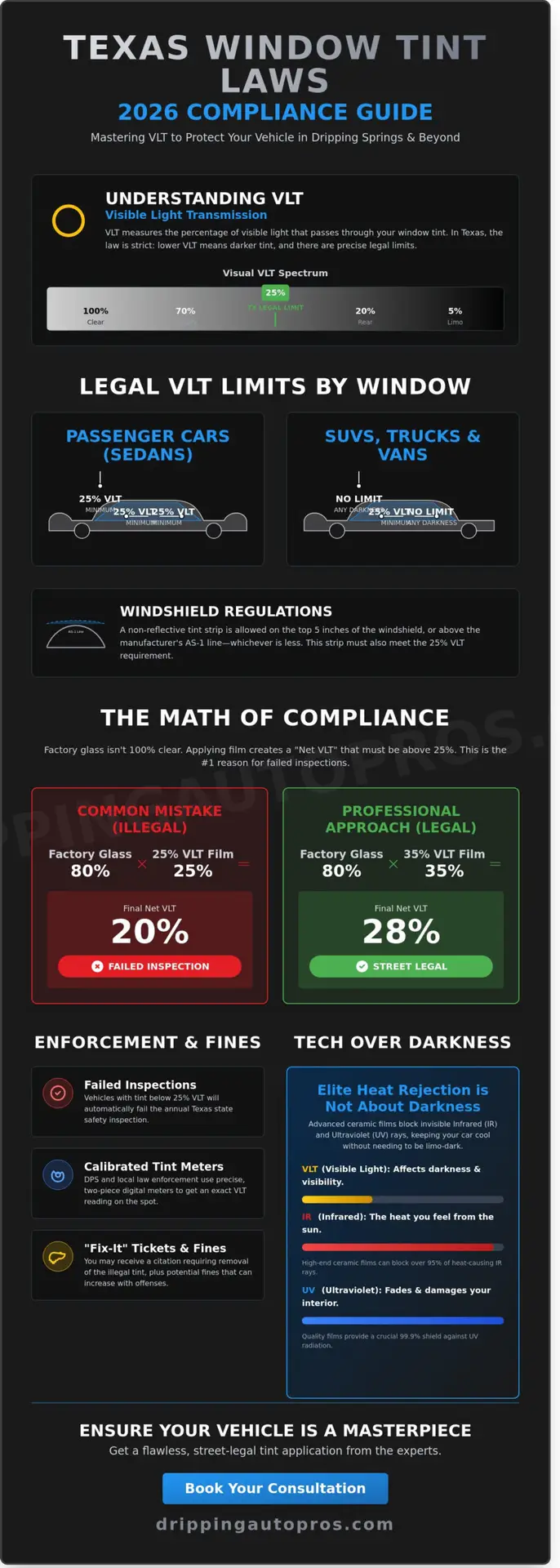
Maintaining the aesthetic integrity and safety of your vehicle starts with mastering the specifics of legal tint in texas. The foundation of these rules is Visible Light Transmission (VLT), a technical measurement of the light allowed to pass through the window and film combination. For the 2026 calendar year, Texas law requires that front side windows allow at least 25% of light to enter the cabin. This specific percentage is not a suggestion; it is a calculated safety requirement designed to ensure Dripping Springs drivers maintain clear sightlines during nighttime driving and inclement weather. Our team treats every installation as a masterpiece, ensuring the film applied to your glass integrates seamlessly with the factory specifications to hit this precise mark.
The 2026 regulations place a heavy emphasis on the safety of both the driver and law enforcement officers. A high-quality film functions as a sophisticated armor against the Texas sun, but it must never obstruct the ability of an officer to identify occupants during a roadside interaction. Drivers must also differentiate between factory-installed privacy glass and professional aftermarket applications. Privacy glass is often found on the rear windows of SUVs and trucks, where the glass itself is tinted during manufacturing. Understanding Window Film and its various iterations is essential, as aftermarket films provide superior heat rejection and UV protection that factory glass often lacks. We meticulously measure the net VLT of both the glass and the film to ensure the final result remains within the legal limit.
The Role of the Texas Department of Public Safety (DPS)
The DPS dictates the rigorous standards for annual vehicle inspections across Hays County. Inspectors utilize calibrated tint meters, specifically two-piece devices that sandwich the glass to provide a digital VLT reading. If your film measures below 25%, the vehicle fails inspection. There is no grandfathering for older installations in 2026; every vehicle on the road must comply with current safety statutes to maintain registration. Our Pros ensure your investment meets these standards before you ever leave the shop.
VLT Percentages: A Practical Visual Guide
Achieving the perfect look requires comparing different grades. While 5% VLT provides a “limo” appearance and 20% is common for rear windows, the 25% limit is the legal standard for front doors. Interior colors significantly impact perception. A dark charcoal leather interior makes legal tint in texas appear deeper and more private than a tan or grey cabin. This 25% level is the Austin-area sweet spot, offering unrivaled UV protection while keeping your vehicle fully compliant with state law.
VLT Limits for Each Window: What is Legal in Texas?
Achieving a flawless aesthetic for your vehicle requires more than just high-quality film; it demands a meticulous understanding of state regulations. In the heat of the Texas sun, window tint serves as a critical shield for your interior, yet the law is precise about how much light must penetrate the glass. For any enthusiast in Dripping Springs, maintaining the balance between a sleek, darkened look and legal tint in texas is the standard of a true professional.
Texas law distinguishes between passenger cars, such as sedans, and multi-purpose vehicles like SUVs or trucks. While the front side windows maintain a strict 25% VLT (Visible Light Transmission) limit across all vehicle types, the rules for rear side windows diverge. Owners of SUVs and trucks enjoy the freedom of “open” VLT limits for all glass behind the driver, whereas sedan owners must typically adhere to the 25% standard for rear side windows as well.
Front Side Windows: The 25% VLT Threshold
The driver and front passenger windows are governed by a strict 25% VLT requirement to ensure law enforcement visibility and driver safety. It is a common mistake to assume that applying a 25% film results in a 25% reading. Most factory glass arrives with a subtle natural tint, often measuring around 70% to 80% VLT. When our specialists apply film, we account for this cumulative effect to prevent your vehicle from falling into a non-compliant range. To ensure absolute compliance, the net VLT calculation is the product of the window film’s rated percentage and the glass’s native light transmission. Consult the Texas Window Tinting Standards to verify how these percentages are measured during official inspections.
Rear Side and Back Windows
The regulations for the rear of the vehicle offer more flexibility for those seeking ultimate privacy and heat rejection. If your vehicle is equipped with dual side mirrors, the rear windshield has no VLT limit, allowing for the deepest shades available. This is a vital investment for families in our community, as darker rear tint provides unrivaled protection for children in car seats against harsh UV rays.
While the temptation to match the front windows to a dark rear glass is strong, doing so often leads to legal complications and failed inspections. We recommend a staggered approach that maintains a sophisticated cadence while staying within the 25% limit for the front. If you are ready to transform your vehicle with a precision installation, the specialists at Dripping Auto Pros
Windshield Tinting and the AS-1 Line Requirements
The windshield represents the most scrutinized glass on your vehicle during a state inspection. Achieving a legal tint in texas requires a precise understanding of the AS-1 line. This small mark, etched into the glass by the manufacturer, dictates the boundary for sun strips. If your vehicle lacks this mark, state law defaults to the top five inches of the windshield. Applying dark film below this threshold creates a significant legal liability and compromises visibility during night driving on dark Hill Country roads.
According to the Texas window tinting standards, any film applied to the top of the windshield must be non-reflective. While many drivers desire a full-windshield shade for maximum relief, doing so with darkened film remains illegal in 2026. However, modern technology offers a sophisticated solution for heat rejection. Installing clear ceramic film across the entire windshield serves as a legal method to block 99% of UV rays and significant infrared heat without darkening the glass beyond state limits. This treatment acts as an invisible shield, preserving the pristine clarity of your view while protecting your interior from the relentless sun. For a deeper dive into these specialized applications, explore our guide on Front Windshield Tint in Dripping Springs: Texas Laws & Heat Protection (2026).
The AS-1 Line and Top-Strip Regulations
The AS-1 line serves as the definitive legal border for darkened films. Texas statutes permit a sun strip above this line to reduce glare, provided the material is non-reflective. We often see DIY applications fail inspection because they extend just a fraction of an inch too low. A professional installation ensures the film follows the exact curvature of your glass, maintaining a flawless look that complies with every 2026 regulation. This precision prevents the “bubbling” often seen on inferior jobs, ensuring your investment remains an asset rather than a liability.
Reflectivity and Color Restrictions
Texas law is explicit regarding the appearance of your tint. Any film applied to the windshield strip cannot have a luminous reflectance rating higher than 25%. This prevents the mirror effect that can blind oncoming traffic. Additionally, the state strictly prohibits specific colors. Red, amber, and blue films are illegal because they can be confused with emergency vehicle lighting. From a Master Craftsman’s perspective, high-reflectivity films often detract from a vehicle’s sophisticated lines. We recommend deep charcoals or neutral blacks that complement the factory finish. This ensures your car looks like a masterpiece rather than a machine with aftermarket clutter. Achieving a legal tint in texas is about balancing high-end protection with a refined, understated aesthetic that respects both the law and the vehicle’s design.
Enforcement, Fines, and Inspection Compliance
Driving through Hays County with non-compliant film is a calculated risk that rarely pays off. Dripping Springs police and Texas Department of Public Safety (DPS) troopers utilize portable tint meters, specifically photometers like the Laser Labs Model 200, to measure light transmission during routine traffic stops. These devices provide an instant digital readout of your window’s Visible Light Transmission (VLT). If your front side windows register below the 25% threshold required for legal tint in texas, you face an immediate compliance challenge.
The cost of a violation isn’t just a minor inconvenience; it’s a financial and legal burden. A citation for illegal tint is typically classified as a Class C misdemeanor. While a first-time “fix-it” ticket might carry a lower administrative fee if you prove the film was removed, recurring offenses can lead to fines reaching $1,000 under Texas Transportation Code § 547.613. To avoid these penalties and the frustration of roadside delays, many local enthusiasts choose Professional Window Tint Removal in Dripping Springs: The Complete Guide to return their vehicle to a pristine, compliant state before enforcement becomes an issue.
The Inspection Process in Hays County
As we move into 2026, the Texas state inspection remains a critical gatekeeper for vehicle registration. Inspectors at local stations are trained to identify aftermarket films and will use a two-piece tint meter to verify VLT levels on every vehicle. If your tint fails to meet the 25% standard, the inspector must fail the vehicle immediately. This prevents you from renewing your registration until the film is stripped and the car is re-inspected. Be particularly cautious when purchasing used vehicles from states like Florida or Arizona, where 15% VLT is often standard; these vehicles will require immediate correction to pass 2026 Texas standards.
Medical Exemptions for Darker Tint
Texas law recognizes that certain drivers require enhanced UV protection due to specific health conditions. Qualifying medical issues include Lupus, Sun Sensitivity, and Porphyria. However, carrying a simple doctor’s note on a prescription pad isn’t sufficient for legal tint in texas compliance. You must submit a formal application to the Texas DPS and receive a signed “Medical Exception” certificate. This document must remain in your vehicle at all times. Even with this exemption, the film must still allow for a certain degree of visibility for law enforcement safety, and the exemption typically only applies to the driver’s side windows. Proper documentation prevents unnecessary friction during encounters with the Master Craftsmen of local law enforcement.
Ensure your vehicle meets every standard of excellence and law. If you’re unsure about your current film’s compliance, contact the specialists at Dripping Auto Pros for a precision evaluation of your vehicle’s glass today.
Beyond Tint: Superior UV & Heat Protection in Central Texas
Many drivers mistakenly believe that the darkest film provides the highest level of defense. While staying within the limits of legal tint in texas is mandatory, darkness alone doesn’t stop the 53% of solar energy that reaches your cabin as infrared (IR) heat. True protection requires an elite, multi-layered strategy that addresses both the visible and invisible spectrums of light. At Dripping Auto Pros, we treat your vehicle as a high-value asset, applying scientific precision to ensure your interior remains 15 to 20 degrees cooler even during a Hill Country August. For a deep dive into local regulations, see our Understanding Texas Tint Laws: A Comprehensive Guide for Dripping Springs Residents.
Our Master Craftsman approach focuses on the preservation of every surface. We understand that the intense Texas climate creates a hostile environment for premium automotive materials. By integrating advanced chemical engineering with precision installation, we provide a shield that goes far beyond a simple aesthetic upgrade. We don’t just tint windows; we engineer a climate-controlled sanctuary that protects your financial and emotional investment.
Ceramic Coating for Glass and Surfaces
The windshield acts like a massive magnifying glass, focusing UV rays directly onto your leather and dashboard. We mitigate this risk using Feynlab Ultra Ceramic coating. This professional-grade solution creates a permanent chemical bond that rejects 99% of UV radiation. It’s the ideal companion to a 25% VLT film because it adds a hydrophobic shield without altering the clarity of your glass. Our specialists apply these coatings to ensure every surface resists the fading and cracking typically caused by the relentless sun. This invisible armor keeps your cabin pristine while maintaining full compliance with legal tint in texas.
Paint Protection Film (PPF) as a Heat Shield
Heat doesn’t just attack through the windows; it saturates your vehicle’s body panels and degrades the clear coat. Our Paint Protection Film serves as a transparent suit of armor against rock chips and solar oxidation. By combining PPF with Revivify self-healing coatings, we create a synergistic barrier that actually heals itself from swirl marks using the sun’s own energy. This dual-layer defense preserves the flawless factory finish while adding a significant layer of thermal insulation to the car’s exterior.
- Blocks 99% of harmful UV-A and UV-B rays
- Reduces surface temperatures on dark paint by up to 15 degrees
- Provides a self-healing surface that eliminates micro-scratches
- Maintains the resale value of your high-end vehicle
Choosing the right protection is about more than just following the law. It’s about achieving a standard of excellence that keeps your car looking and feeling like a masterpiece for years to come. Protect your investment with Dripping Auto Pros today.
Master the Road with Compliance and Unrivaled Protection
Adhering to the 2026 regulations for legal tint in texas means more than just avoiding a citation; it’s about optimizing your driving experience for safety and comfort. Maintaining the mandatory 25% VLT on front side windows and respecting the AS-1 line requirements ensures your vehicle passes inspection without delay. These standards protect your visibility while our high-performance films block 99% of solar heat and UV radiation. We treat every car that enters our Dripping Springs studio as a high-value asset requiring a master’s touch.
As a veteran-owned and operated business, we pride ourselves on being the local authority for paint correction and PPF. Our status as certified Revivify and Feynlab installers means your vehicle receives a protective shield that’s both technically superior and aesthetically flawless. Don’t settle for basic upgrades when you can invest in long-term preservation and professional-grade armor. Our team applies the same discipline to window film that we bring to elite paint restoration, ensuring your investment remains pristine for years to come.
Maintaining a high standard of living in Texas often involves finding reliable partners for various needs. While we focus on automotive preservation in Dripping Springs, those in the North Texas region can find excellent home service support through DFW SpinCycle Rentals, which specializes in convenient appliance solutions for local residents.
Secure Your Vehicle’s Future with Premium Protection at Dripping Auto Pros
We’re ready to help you achieve the perfect balance of sophisticated style and state compliance.
Frequently Asked Questions
Is 20% tint legal in Texas for the front windows?
No, 20% tint is illegal on front side windows because Texas law requires a minimum of 25% light transmission. This regulation ensures law enforcement visibility and driver safety during nighttime navigation. Our specialists at Dripping Auto Pros utilize precision meters to verify that your legal tint in texas meets these exact standards. Choosing a compliant film protects you from unnecessary legal complications while maintaining a sophisticated aesthetic for your vehicle.
Can I tint my full front windshield in Texas if it’s clear?
You cannot legally apply window film to the entire surface of your front windshield in Texas. State regulations restrict tinting to the area above the AS-1 line or the top five inches of the glass. While clear ceramic films provide exceptional heat rejection, they must remain within these designated boundaries to pass inspection. This rule applies to all passenger vehicles registered in Hays County and across the state to maintain clear driver sightlines.
What happens if I fail my Texas vehicle inspection due to window tint?
Your vehicle will receive a failing status if the window film measures below the 25% threshold during a safety inspection. Texas Department of Public Safety guidelines require inspectors to use calibrated light meters on every vehicle during the annual check. If your car fails, you must remove the non-compliant film and return for a re-inspection within 15 days. We often help local drivers replace subpar installations with premium, road-legal alternatives that meet every state requirement.
Are there specific colors of window tint that are illegal in Texas?
Texas law specifically prohibits the use of red, amber, and blue window tints on any vehicle window. These colors are reserved for emergency services and can interfere with the visibility of traffic signals or brake lights. Most high-end ceramic and carbon films come in neutral charcoal or black tones that enhance your car’s profile without violating state statutes. We recommend sticking to these classic shades for a timeless, professional appearance that avoids unwanted police attention.
How much is a window tint ticket in Texas in 2026?
A citation for illegal window tint in Texas can cost up to $275 per occurrence when including standard court fees. These tickets are often issued as “fix-it” citations, but the financial burden adds up quickly if you ignore the violation. Beyond the initial fine, you’ll face the additional expense of professional film removal and glass cleaning. Investing in a legal tint in texas from the start prevents these avoidable costs and preserves your peace of mind on the road.
Does Texas require a sticker to prove my window tint is legal?
Texas Administrative Code requires a compliance sticker positioned between the film and the glass on the driver’s side front window. This small label serves as a certification from the installer that the film meets the 25% light transmission requirement. At Dripping Auto Pros, we ensure every installation includes this vital marker of authenticity. It’s a hallmark of professional craftsmanship that simplifies your interactions with state inspectors and law enforcement officers during routine stops.
Can I have ‘limo tint’ (5% VLT) on my back windows in Dripping Springs?
You can legally apply 5% VLT limo tint to the rear side windows and the back windshield of your vehicle. Texas does not impose a darkness limit on these specific windows, provided the car has dual exterior side mirrors. This allows for maximum privacy and superior heat rejection for passengers in the back seat. Our Dripping Springs clients frequently choose this ultra-dark option to create a sleek, protective shield for their high-value interior cabin assets.
Is ceramic tint legal in Texas if it’s darker than 25%?
Ceramic tint is subject to the same 25% light transmission limit as any other film technology on front side windows. While ceramic film offers unrivaled infrared heat rejection, its advanced composition doesn’t grant an exemption from state law. A 15% ceramic film is just as illegal as a 15% dyed film on your front doors. We focus on pairing high-performance ceramic technology with legal shades to deliver the ultimate balance of heat protection and legal compliance.