In the 100-degree Dripping Springs sun, a single bird dropping isn’t just a mess; it’s a concentrated chemical burn with a corrosive pH level between 3.0 and 4.5. When your car’s clear coat expands in the Texas heat, it allows these acidic proteins to sink deep into the finish, often leaving behind a permanent “ghost” etch that standard washing cannot touch. You’ve likely felt the frustration of scrubbing a spot only to realize you’ve swapped a stain for a cluster of fine scratches. We understand that your vehicle is a masterpiece that deserves more than a trial-and-error approach.
This guide details the 2026 professional standards for bird dropping stain removal from car paint to restore your finish to its pristine state. You’ll learn how to safely neutralize uric acid before it traps itself in your clear coat and how to identify when a Level 1 paint correction is necessary to erase existing damage. We also explore the latest protective shields, including Revivify self-healing coatings and SunTek Reaction Matte PPF, which ensure your automotive investment remains flawless regardless of what the Central Texas sky drops your way.
Key Takeaways
- Understand how the intense Central Texas heat accelerates the corrosive power of uric acid, turning a simple surface mess into a deep chemical burn within hours.
- Master the “neutralization first” rule for safe bird dropping stain removal from car paint, ensuring you lift contaminants without inducing permanent scratches or swirl marks.
- Learn the professional diagnostic techniques, including the fingernail test and LED light inspections, to distinguish between topical stains and sub-surface clear coat etching.
- Discover why meticulous paint correction is the only way to erase “ghost” stains and how microscopic leveling can restore your vehicle’s finish to its original luster.
- Explore the concept of sacrificial layers, utilizing premium ceramic coatings and PPF to provide a high-end shield that defends your automotive investment against future incidents.
The Science of Etching: Why Bird Droppings are Dangerous in the Dripping Springs Heat
In Central Texas, the aesthetic integrity of your vehicle faces a relentless adversary that most owners underestimate. While a bird dropping might seem like a simple cosmetic nuisance, it’s actually a biological landmine. Paint etching is a chemical reaction that physically alters the clear coat’s topography. In our unique climate, this process doesn’t take days; it can begin in a matter of minutes. When the mercury climbs past 100 degrees in Dripping Springs, your car’s exterior isn’t just sitting there. It’s reacting. Understanding the chemistry behind this damage is the first step toward effective bird dropping stain removal from car paint and long-term preservation of your automotive investment.
Uric Acid vs. Your Clear Coat
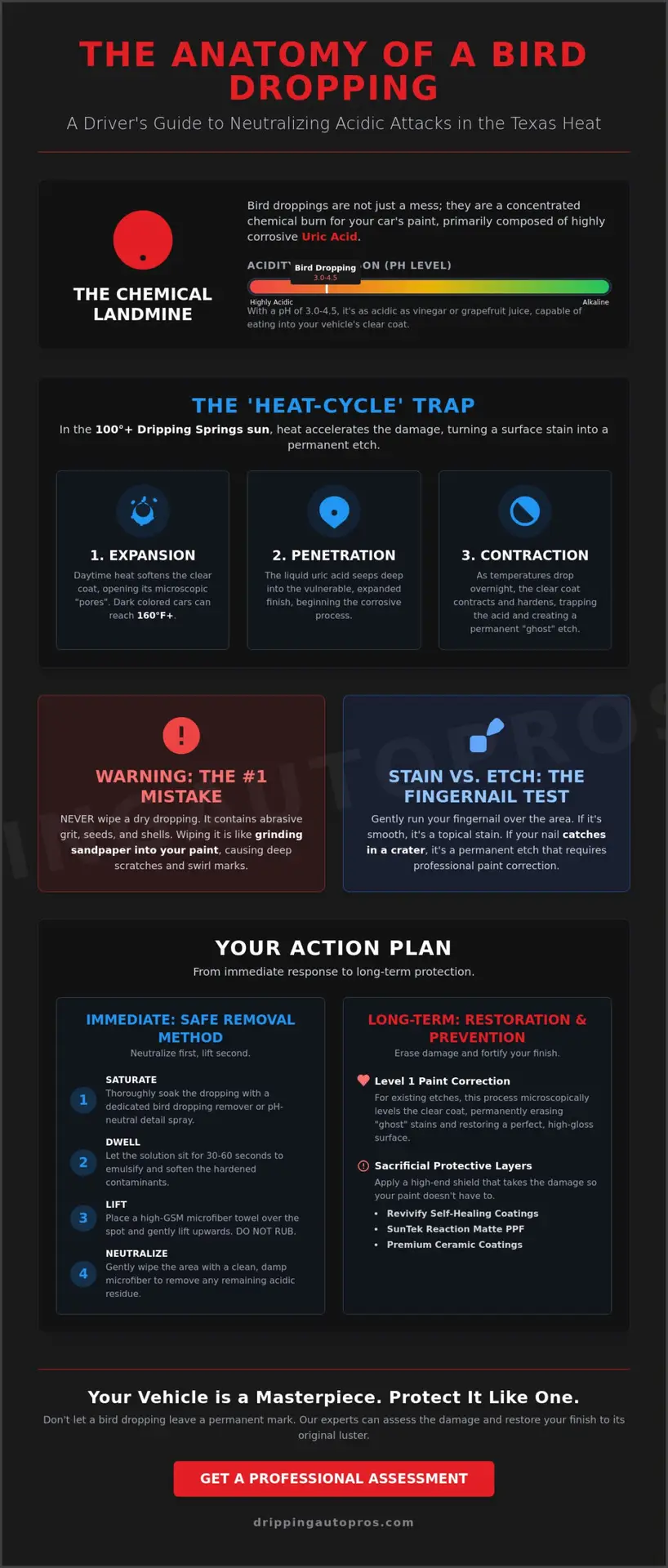
The primary culprit is uric acid, a highly corrosive substance with a pH level typically ranging from 3.0 to 4.5. For context, this is roughly equivalent to the acidity of vinegar or grapefruit juice. Modern automotive paint systems are designed to be resilient, but they’re increasingly composed of water-based materials that are more susceptible to chemical burns than the high-VOC solvent paints of the past. When a dropping lands on a surface exposed to a high UV index, the sun acts as a catalyst. This heat accelerates the chemical reaction, allowing the acid to eat into the clear coat with alarming speed. Waiting even 24 hours during a Texas summer often means the difference between a simple wipe-down and the need for professional Level 1 paint correction.
The ‘Heat-Cycle’ Trap
The real danger in Dripping Springs lies in the thermal expansion of your vehicle’s surfaces. As the sun beats down, the clear coat expands and softens, essentially opening the “pores” of the finish. This expansion allows the semi-liquid uric acid to sink deeper into the paint structure. Dark-colored cars are at the highest risk, as surface temperatures on a black or navy hood can easily exceed 160 degrees, far hotter than the ambient air. The damage is then sealed during the cooling phase:
- Expansion: Daytime heat softens the clear coat, allowing acidic contaminants to penetrate the surface.
- Penetration: The uric acid begins its corrosive work, dissolving the microscopic layers of the finish.
- Contraction: As temperatures drop in the evening, the clear coat hardens and contracts around the contaminant.
- The Bite: This “mechanical bite” traps the acidic residue and the resulting texture change, leaving behind a permanent “ghost” stain.
Once this cycle completes, the bird dropping stain removal from car paint becomes a task for a master craftsman. The stain is no longer on the paint; it’s part of it. At this stage, standard cleaning won’t suffice because the topography of the clear coat has been physically reshaped into a dull, fractured crater that requires precise leveling to restore.
Safe Removal Tactics: How to Clean Fresh Droppings Without Scratching
When you spot a fresh contaminant on your hood, the immediate instinct is to grab a napkin and wipe it away. This is the most common way owners unintentionally damage their clear coat. Our philosophy at Dripping Auto Pros is “neutralization first.” Rubbing a dry dropping is akin to grinding sandpaper into your finish because bird droppings often contain seeds, shells, and grit that act as aggressive abrasives. For successful bird dropping stain removal from car paint, you must emulsify the deposit before it ever touches a towel. This meticulous approach is the cornerstone of our professional auto detailing in Dripping Springs, where we prioritize chemical decontamination to preserve the masterpiece that is your vehicle.
The 4-Step Professional Soften-and-Lift Method
To safely manage these incidents at home, you need the right arsenal. We recommend keeping a high-GSM (grams per square meter) microfiber towel and a pH-neutral lubricant in your trunk. Follow this disciplined process to ensure a scratch-free result:
- Step 1: Saturate. Thoroughly soak the area with a dedicated waterless wash or high-lubricity quick detailer. Do not use plain water, as it lacks the surfactants needed to encapsulate grit.
- Step 2: Dwell Time. Place a microfiber towel soaked in the lubricant directly over the spot. Let it sit for 2 to 3 minutes. This allows the solution to break down the hardened uric acid safely.
- Step 3: The Pinch. Instead of wiping, gently “pinch” the towel and lift the residue vertically. This motion pulls the contaminant away from the surface rather than dragging it across the paint.
- Step 4: Final Inspection. Rinse the area with a fresh mist of detailer and wipe with a clean section of the towel. Use a bright light to check for any remaining “ghost” marks or surface etching.
Common DIY Mistakes to Avoid
The difference between a clean car and a damaged one often comes down to the materials used in the first 60 seconds. Many owners reach for paper towels or napkins, but these are wood-based products that are surprisingly abrasive to modern paint. They will leave a cluster of fine swirl marks that only a professional Level 1 paint correction can remove. Avoid household cleaners like Windex or dish soap; the former contains ammonia which can cloud your clear coat, while the latter strips away your existing wax or sealant, leaving the paint defenseless. Finally, never attempt to scrape a dried dropping with your fingernail. This localized pressure almost certainly results in a deep scratch that penetrates the clear coat’s protective layer.
Identifying Permanent Damage: When a Stain Becomes an Etch
After you’ve performed the soften-and-lift method, the surface may appear clean at a glance. However, a master craftsman knows that the residue is only the first layer of the problem. Successfully navigating bird dropping stain removal from car paint requires more than just a clean surface; it demands a diagnostic eye to determine if the uric acid has physically altered your vehicle’s clear coat. To see the truth, you must use a high-output LED inspection light or the direct midday Texas sun. Look for a “ghost,” which is a faint, cloudy outline that remains visible even after the paint is dry. If the light refracts differently in that specific spot, the surface is no longer level.
A simple yet effective diagnostic tool is the “fingernail test.” Gently run your nail across the affected area. If you feel a slight indentation or a rough, sandpaper-like texture, the clear coat’s integrity has been compromised. This isn’t a topical mineral deposit that you can simply wash away; it’s a physical crater in the protective layer of your automotive paint. If the surface feels smooth but the stain remains visible, you’re likely dealing with a topical chemical mark. If it feels rough, the acid has successfully eroded the paint’s topography.
The Anatomy of a ‘Ghost’ Stain
A ghost stain occurs when the acid changes how light travels through the clear coat. Type I etching is a surface-level topical mark that hasn’t yet fractured the paint. Type II etching, however, represents a sub-surface fracture where the acid has eaten deep enough to create a microscopic valley. In the 2026 automotive market, where clear coats are becoming thinner to meet environmental standards, the transition from a Type I stain to a Type II etch can happen in as little as four hours under the intense Dripping Springs sun.
When DIY Restoration Reaches Its Limit
Frustration often leads owners to reach for aggressive “all-in-one” rubbing compounds found at big-box retailers. Without a professional paint thickness gauge, you’re flying blind. Modern clear coats are only about as thick as a post-it note; removing too much material in a localized area can lead to “strike-through,” where you burn entirely through the clear coat to the base color. When a stain refuses to budge after a light hand-polish, it’s time to stop. At this stage, the safest path forward is to consult a specialist for professional paint correction. Professional detailers in 2026 typically charge between $150 and $400 to fix the damage from a single severe etch, a small price to pay compared to the thousands required for a panel respray if a DIY attempt goes wrong.
Professional Restoration: Using Paint Correction to Erase Ghost Stains
When the “ghost” of a chemical burn remains visible after a thorough cleaning, you have transitioned from simple maintenance into the complex territory of car paint repair. At this stage, bird dropping stain removal from car paint is no longer about washing; it is a surgical process of microscopic leveling. We treat your vehicle’s finish as a masterpiece that requires a disciplined, multi-stage approach to restore its unrivaled clarity. Before any machine touches the surface, our specialists utilize ultrasonic paint thickness gauges to measure the remaining clear coat in microns. This data ensures we have enough material to safely level the etch without compromising the long-term integrity of your automotive investment.
The Leveling Process
Restoring a surface fractured by uric acid requires a meticulous balance of friction and heat. We utilize a combination of rotary polishers for deep defect removal and dual-action polishers for the final refining stages. The process involves removing a microscopic layer of the surrounding clear coat to bring the entire panel down to the same depth as the “valley” created by the acid. We carefully select abrasive grits based on the severity of the damage, moving from heavy cutting compounds to ultra-fine finishing polishes. This precision work erases the texture of the etch and builds toward the Dripping Auto Pros signature deep gloss, resulting in a flawless, mirror-like finish that hand-polishing simply cannot achieve.
Why Studio-Based Detailing Wins Over Mobile
True paint correction is impossible to perform effectively in a driveway. While mobile services offer convenience, they lack the controlled environment necessary for high-end craftsmanship. Our studio-based approach provides three critical advantages for bird dropping stain removal from car paint:
- Precision Lighting: We use high-CRI (Color Rendering Index) LED arrays that mimic different sun angles, revealing sub-surface defects that are invisible in standard outdoor light.
- Contamination Control: A single grain of dust caught under a polishing pad can cause deep “pigtail” scratches. Our dust-free studio environment eliminates this risk entirely.
- Temperature Stability: Leveling clear coat requires managing surface heat. In the Dripping Springs sun, paint becomes too soft to polish predictably; our climate-controlled facility ensures consistent, safe results.
If your vehicle is suffering from deep, sun-baked etching that disrupts its pristine aesthetic, it’s time to move beyond DIY attempts. We invite you to schedule a Level 2 Paint Correction consultation to see how our master craftsmen can restore your finish to its original glory.
Fortifying Your Finish: Preventing Future Bird Dropping Damage
While mastering the technique for bird dropping stain removal from car paint is essential, the ultimate goal of a Master Craftsman is to ensure that your vehicle’s clear coat never faces a direct chemical assault. Traditional waxes and retail-grade sealants are largely obsolete in the Central Texas climate. Carnauba wax begins to soften at 140 degrees, a temperature frequently exceeded on the hood of a car parked in Dripping Springs. Once the wax softens, it offers zero resistance to the 3.0 pH uric acid found in bird droppings. To truly preserve your automotive investment, you must shift your strategy from reactive cleaning to proactive fortification using a sacrificial layer that takes the hit so your paint doesn’t.
The most robust physical barrier available in 2026 is Paint Protection Film (PPF). Leading products like XPEL Ultimate Plus or SunTek Ultra act as a transparent armor, providing a dense polyurethane shield that acid simply cannot penetrate. For owners seeking a full vehicle wrap, costs in 2026 typically range from $7,500 to $11,500, but the peace of mind it provides against environmental etching is unrivaled. When a dropping lands on PPF, the film absorbs the chemical attack, leaving the original factory paint pristine underneath.
Ceramic Coatings as a Chemical Shield
For those who prefer the deep, glass-like finish of a liquid coating, Feynlab Ultra ceramic coatings provide a sophisticated chemical defense. These next-generation formulations are engineered for longevity, with premium options now offering a lifespan of up to 15 years. The secret lies in their extreme hydrophobic properties; contaminants cannot easily bond to the surface. This creates a much larger window of opportunity for safe bird dropping stain removal from car paint. Instead of etching in minutes, the acid sits on top of the coating, allowing for a stress-free removal process. Additionally, these 2026 formulations are more environmentally conscious, with some eco-friendly coatings reducing VOC emissions by as much as 85 percent.
Revivify: The Self-Healing Advantage
The pinnacle of modern paint protection is the Revivify Self-Healing Coating. Unlike traditional ceramic coatings that are rigid, Revivify is a flexible, heat-activated shield that uses the intense Texas sun to its advantage. When the surface is exposed to heat, the coating actually flows back into its original state, effectively “healing” minor surface etch marks and swirl marks automatically. It’s a transformative solution for high-value assets in our local community, turning the sun from an enemy that accelerates paint damage into a tool for maintenance. By choosing a self-healing layer, you aren’t just protecting a machine; you’re ensuring your vehicle remains a flawless masterpiece for years to come.
Preserving Your Masterpiece Against the Texas Sky
In the demanding Central Texas climate, protecting your vehicle’s aesthetic integrity requires more than just reactive maintenance. We’ve seen how a single incident leads to permanent clear coat erosion when surface temperatures climb past 160 degrees. You now understand that effective bird dropping stain removal from car paint involves neutralizing the 3.0 pH uric acid before it traps itself in your finish during the nighttime cooling cycle. Whether you’re performing a safe soften-and-lift at home or requiring a Level 2 paint correction to erase deep ghost stains, the standard remains the same: meticulous attention to detail.
At Dripping Auto Pros, we approach every vehicle as a unique masterwork. As a veteran-owned and operated studio, we provide the precision required for high-end automotive restoration. Our certified Revivify and Feynlab installers specialize in creating a hydrophobic shield that defends your investment for a lifespan of up to 15 years. Restore your vehicle’s pristine finish with a professional consultation at Dripping Auto Pros. Your journey toward a flawless, unrivaled finish begins with a commitment to professional excellence.
Frequently Asked Questions
How long does it take for bird poop to damage car paint?
Damage can begin in as little as 10 to 15 minutes when surface temperatures exceed 100 degrees. In the intense Dripping Springs sun, the thermal expansion of your clear coat allows uric acid to penetrate the finish almost immediately. This rapid chemical reaction is why we emphasize immediate neutralization before the evening cooling cycle traps the contaminant within the paint’s structure.
Can I use vinegar to remove bird dropping stains?
You should avoid using vinegar for bird dropping stain removal from car paint because it is highly acidic. With a pH level typically around 2.5, vinegar can further compromise a clear coat that is already weakened by the uric acid in the dropping. Instead, utilize a pH-neutral lubricant or a dedicated waterless wash to safely encapsulate and lift the debris without adding chemical stress to the surface.
Is it safe to use a pressure washer to remove bird poop?
A pressure washer is safe if you use a wide fan tip at a distance of at least 12 to 18 inches from the panel. However, you should never use high pressure to blast a dry, hardened dropping. The grit and seeds within the deposit can be driven into the paint by the water pressure, causing deep scratches. Always soften the area with a lubricant first.
Why does a stain remain even after I’ve washed the bird poop off?
A persistent mark indicates that the acid has physically etched the clear coat. This “ghost stain” isn’t a residue sitting on the surface; it’s a physical change in the paint’s topography. The acid has dissolved a microscopic layer of the finish, creating a dull, fractured crater that requires professional leveling through paint correction to disappear and restore the deep gloss.
Will ceramic coating protect my car from bird droppings?
Ceramic coatings like Feynlab Ultra provide a critical sacrificial layer that resists chemical attacks. While not 100 percent bulletproof, the coating’s hydrophobic properties prevent the dropping from bonding tightly to the surface. This significantly extends your window of opportunity to remove the contaminant before the acid can reach and damage the underlying factory paint.
What should I do if the bird dropping has already etched into the paint?
If etching has occurred, the only reliable method for bird dropping stain removal from car paint is professional paint correction. Attempting to buff this out by hand often results in an uneven finish or “strike-through” of the clear coat. Professional detailers in 2026 typically charge between $150 and $400 to restore the damage from a single severe bird dropping incident.
Can bird droppings damage Paint Protection Film (PPF)?
High-end Paint Protection Film is highly resistant to uric acid, but it can suffer surface staining if the acid sits for an extended period in the sun. The primary advantage of PPF is that the damage is confined to the film itself. This sacrificial layer can often be healed with heat or replaced, leaving the expensive factory paint untouched and pristine.
Is bird dropping removal covered by my car insurance?
Most standard automotive insurance policies do not cover bird dropping damage. Insurance companies generally classify this as environmental damage or wear and tear rather than a comprehensive claim event. This makes the investment in a professional protective shield, such as Revivify or PPF, an essential part of preserving your vehicle’s long-term resale value and aesthetic appeal.