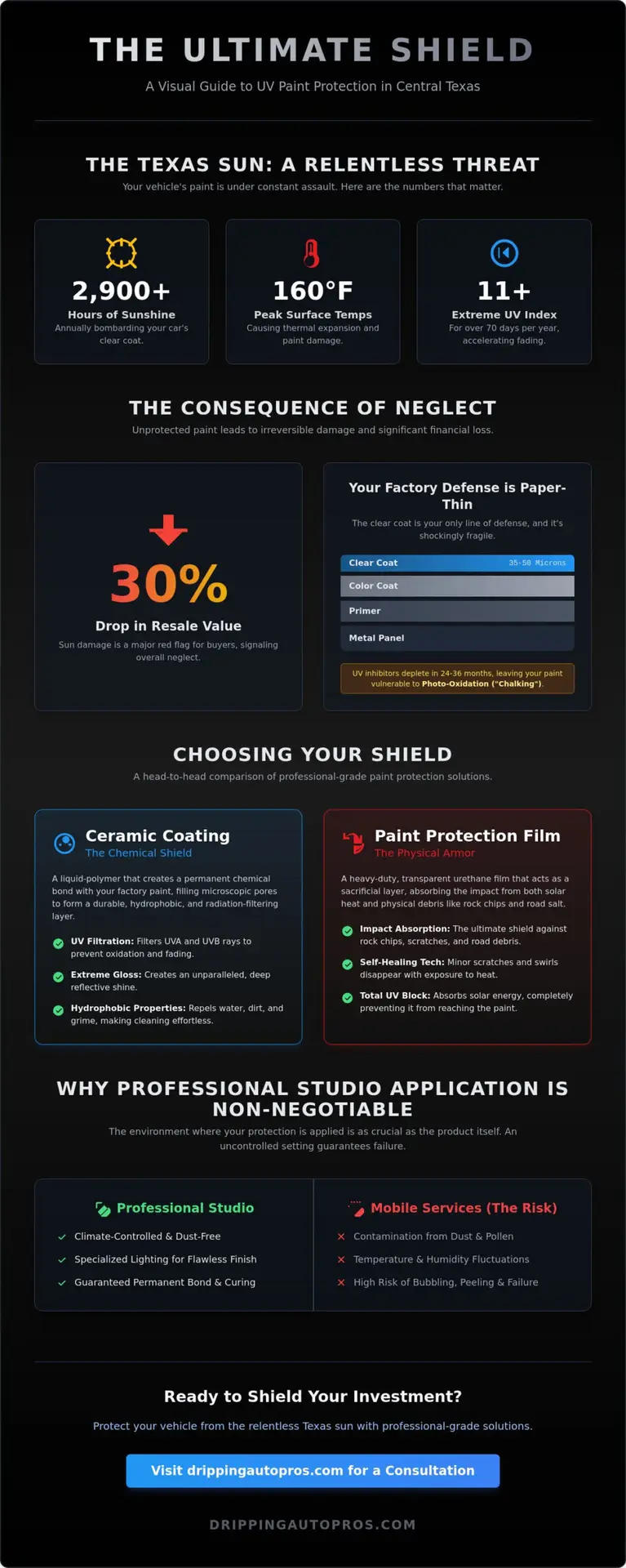
Your car’s paint is under constant siege from a force that delivers over 2,900 hours of relentless sunshine to Central Texas every single year. This intense radiation creates a slow-motion collision with your clear coat. This leads to the chalky oxidation often seen on roofs and hoods across Austin. Utilizing professional UV paint protection for cars in Texas is no longer a luxury; it’s a necessary defense for owners who want to avoid the 30 percent drop in resale value that typically follows visible sun damage.
You’ve likely felt the frustration of watching a once-pristine finish lose its depth or worried about low-quality films yellowing and peeling in the heat. At Dripping Auto Pros, we agree that your vehicle is a masterpiece that deserves a higher standard of preservation. This guide will show you how to shield your investment using professional-grade coatings and films specifically engineered for the Hill Country climate. We’ll explore the meticulous processes that maintain a flawless showroom shine and make maintenance effortless, even when the local limestone dust is at its worst.
Key Takeaways
- Understand how the relentless Texas UV index triggers photo-oxidation, threatening the pristine finish of your factory clear coat with premature aging and “chalking.”
- Discover the technical differences between ceramic coatings and PPF to identify the ultimate UV paint protection for cars in Texas.
- Learn why Dripping Springs’ unique environmental factors, such as limestone dust and Highway 290 debris, necessitate a professional-grade defensive shield.
- Uncover why a climate-controlled studio application is the only way to ensure your vehicle’s protective layers achieve an unrivaled, permanent bond.
The Science of UV Damage in Dripping Springs
In the heart of the Hill Country, the sun behaves as a relentless chemical catalyst. The 2026 Texas UV index is projected to reach extreme levels of 11 or higher for more than 70 days annually, creating a punishing environment for any vehicle parked outdoors. This constant bombardment triggers photo-oxidation. This chemical process occurs when ultraviolet radiation breaks the molecular bonds of the paint’s resin, causing the surface to lose its ability to reflect light. The result is a dull, chalky appearance that signals the degradation of your car’s aesthetic appeal and structural integrity.
Beyond the chemical breakdown, high-performance vehicles in Dripping Springs face a physical threat known as thermal expansion. As surface temperatures on dark-colored cars climb toward 160 degrees Fahrenheit during a typical July afternoon, the metal panels expand. This expansion causes the microscopic pores of the paint to open, allowing road salts, bird droppings, and industrial fallout to become embedded deep within the finish. When the temperature drops at night, the paint contracts, trapping these contaminants and accelerating the breakdown of the finish from the inside out. Securing high-quality UV paint protection for cars in Texas is the only way to arrest this cycle of decay and preserve your vehicle’s value.
Protecting your investment is about more than just vanity; it’s a financial strategy. Professional appraisals in Central Texas show that vehicles with visible sun damage and clear coat failure can see a 20 percent reduction in resale value. Buyers in the luxury and enthusiast markets prioritize a pristine finish, viewing faded paint as a sign of overall mechanical neglect.
Why Factory Paint Isn’t Enough
Modern Automotive paint systems consist of a primer, a color coat, and a clear coat. While this clear coat is designed to shield the pigment, it’s often no thicker than a post-it note, measuring between 35 and 50 microns. In the harsh climate of Central Texas, the sacrificial UV inhibitors baked into factory finishes typically deplete within 24 to 36 months. Without an additional layer of UV paint protection for cars in Texas, your vehicle is essentially naked against the elements after its third summer. A surface shine might remain, but the deep-layer protection required to prevent cracking and peeling is often gone long before the car is paid off.
Signs Your Car is Already Suffering from Sun Damage
Early signs of sun damage often manifest as a faint cloudiness on horizontal surfaces like the hood, roof, and trunk lid. If you notice a white, powdery residue after washing your car, the clear coat has already begun to disintegrate. At this stage, the damage is no longer merely on the surface. You’ll need a professional paint correction to level the surface and restore clarity before any protective shield can be applied. Our master craftsmen specialize in identifying these early failure points, ensuring that we never seal in defects, but rather restore the finish to its original, flawless state before applying our elite protective coatings.
Comparing UV Protection Technologies: PPF vs. Ceramic Coating
The Central Texas sun generates intense UVA and UVB radiation that penetrates clear coats at a molecular level. To achieve effective UV paint protection for cars in Texas, owners must choose between chemical filtration and physical armor. While both technologies aim to preserve the factory finish, they interact with solar energy in fundamentally different ways. Ceramic coatings utilize nanotechnology to fill microscopic pores in the paint, creating a smooth surface that reflects light and filters radiation. In contrast, Paint Protection Film (PPF) acts as a heavy-duty sacrificial layer that absorbs the impact of both solar heat and physical debris.
Ceramic Coatings for High-Heat Environments
Feynlab Ultra creates a permanent chemical bond with your vehicle’s factory paint. This produces a dense, cross-linked ceramic layer that acts as a primary defense against environmental fallout and industrial pollutants. Because the coating is exceptionally hydrophobic, it prevents mineral-rich water from “baking” into the clear coat during 100-degree Dripping Springs afternoons. This prevents the permanent etching often caused by evaporated rain or sprinkler overspray. You can explore the specific chemical advantages in our complete guide to ceramic coating for more details on this liquid armor.
PPF: The Ultimate Shield Against Texas Roads
While coatings handle the chemistry of the sun, Paint Protection Film provides the only reliable defense against physical rock chips on Highway 290. Modern films utilize advanced aliphatic polyurethane that rejects 99% of UV rays. This advancement is crucial because it prevents the unsightly yellowing and cracking common in older, low-quality installations. The Texas heat actually serves as a maintenance tool for these high-end films. When surface temperatures reach approximately 120 degrees Fahrenheit, the film’s elastomeric polymers naturally reorganize. This allows the material to “heal” swirl marks and light scratches automatically without owner intervention.
For owners seeking the absolute pinnacle of technology, Revivify offers a next-generation hybrid solution. It bridges the gap between traditional coatings and films by providing a flexible, self-healing surface that is significantly thicker than standard ceramic. This carbon-based structure provides unrivaled UV rejection and a deep, mirror-like gloss that doesn’t sacrifice durability. It’s an ideal choice for the enthusiast who demands both aesthetic perfection and rugged resilience against the elements.
Choosing the right technology depends on how you use your vehicle and where you park it daily. If you aren’t sure which layer of defense is right for your lifestyle, our specialists can provide a custom protection consultation to evaluate your vehicle’s specific needs.
Why Dripping Springs Drivers Face Unique Paint Challenges
Living in the Gateway to the Hill Country offers scenic drives and a slower pace of life, yet it presents a hostile environment for any vehicle’s exterior. The local geography and rapid development create a perfect storm of abrasive and chemical threats. Unlike urban environments where smog is the primary concern, Dripping Springs drivers deal with geological and botanical factors that can strip a car’s luster in a single season. High-quality UV paint protection for cars in Texas isn’t just a luxury here; it’s a necessary shield against the specific elements found along the Highway 290 corridor.
The combination of high-speed travel and local construction creates a constant barrage of debris. When you’re cruising at 65 mph toward Austin, even a tiny piece of limestone gravel carries enough kinetic energy to pierce through standard clear coats. Once the paint is chipped, the intense Texas sun begins to bake the edges of the wound, leading to premature peeling and oxidation. This cycle of physical impact followed by thermal stress makes the Hill Country particularly unforgiving for unprotected daily drivers.
- Abrasive Wind: Local gusts carry fine particulate matter that acts like liquid sandpaper over time.
- Organic Acids: Cedar pollen and bird droppings become caustic when heated to 150 degrees or higher.
- Thermal Expansion: Rapid temperature shifts between cool Hill Country nights and blistering afternoons stress the paint’s molecular structure.
The Limestone Dust Dilemma
The white dust common in Dripping Springs is largely composed of calcium carbonate. This limestone dust is significantly more alkaline than standard city grime, often reaching a pH level between 8 and 9. When this dust settles into the microscopic pores of your paint and meets morning dew or a light drizzle, it creates a mild caustic solution. Without a professional barrier, these minerals embed themselves into the finish, making the surface feel rough to the touch. UV paint protection for cars in Texas works by sealing those pores, ensuring that alkaline dust sits on top of a hydrophobic layer rather than inside the paint itself. We recommend a touchless rinse every 7 days for residents living on unpaved ranch roads to prevent dust accumulation from becoming a permanent fixture of the clear coat.
Heat Management for Darker Vehicles
Darker pigments absorb a broader spectrum of light, which converts directly into heat. On a typical 98-degree July day in Dripping Springs, the surface temperature of an unprotected black hood can soar to 170 degrees. This extreme heat causes plastic trim to off-gas, leading to that brittle, gray appearance that ages a vehicle instantly. Utilizing Revivify Self-Healing Coating provides a sophisticated solution to this thermal stress. This advanced technology uses heat to its advantage, allowing the coating to “flow” and self-level, which heals minor swirl marks while reflecting a higher percentage of infrared radiation. By managing the surface temperature, we preserve both the deep gloss of the paint and the structural integrity of the surrounding rubber and plastic components.
Choosing Your Shield: A Guide to the Best UV Protection
Selecting the right defense for your vehicle requires a calculated assessment of your lifestyle and environment. In Central Texas, where we experience over 230 days of sunshine annually, the sun isn’t just a weather pattern; it’s a constant threat to your clear coat. Choosing the right UV paint protection for cars in Texas begins with analyzing how much time your vehicle spends under the direct gaze of the sun. A garage-kept luxury sedan that only sees the light on weekends has vastly different needs than a truck that sits in a driveway in Belterra or Headwaters all day.
Your driving habits also dictate the level of armor required. If your commute involves daily trips on Highway 290, your vehicle faces a dual assault from high-velocity road debris and relentless solar radiation. For these scenarios, we recommend a tiered approach to protection. While a 2-year ceramic coating offers a brilliant shine and basic UV rejection, a 10-year Paint Protection Film (PPF) provides a physical barrier that ceramic alone cannot match. The gold standard for Dripping Springs owners is the “Track Pack” PPF combined with a ceramic top coat. This strategy uses the film to absorb impacts while the ceramic layer provides the hydrophobic properties and deep gloss that enthusiasts demand.
The Daily Driver Package
For the reliable commuter, a Level 1 paint correction paired with a high-grade ceramic coating serves as the essential baseline. This process removes light swirl marks and oxidation before sealing the pores of the paint. It’s a high-value strategy that provides robust UV paint protection for cars in Texas without the higher entry cost of full-body film. To maintain this shield, we recommend a professional decontamination wash every six months to ensure the coating remains free of bonded contaminants that can degrade its UV-blocking capabilities.
The Investment Protection Strategy
Owners of high-performance or sentimental vehicles often opt for a full-front PPF installation. This covers high-impact areas like the bumper, hood, and fenders. To achieve a truly flawless finish, we often utilize Revivify, a state-of-the-art heat-activated coating that offers self-healing properties. This elite combination ensures that any car paint repair you’ve previously invested in remains preserved under a permanent, crystal-clear shield. It’s the ultimate way to lock in perfection and prevent the Texas sun from ever touching your original pigment.
Ready to build a custom defense plan for your vehicle? Contact the specialists at Dripping Auto Pros today to schedule your consultation.
Why Professional Studio Application Outperforms Mobile Services
Achieving the highest level of UV paint protection for cars in Texas isn’t just about the chemical formula in the bottle. It’s about the environment where the science happens. In the Hill Country, the elements are often the greatest enemy of a perfect finish. While mobile detailing offers the allure of convenience, it introduces variables that can compromise the integrity of your vehicle’s armor. A professional studio provides the climate-controlled stability required for ceramic coatings and films to bond at a molecular level, ensuring the protection lasts for years rather than months. We believe that true vehicle preservation requires a level of environmental control that a driveway simply cannot provide.
The Danger of Mobile Coating Installs
Outdoor environments are unpredictable. In Central Texas, humidity levels frequently fluctuate by 40 percent or more within a single afternoon. This moisture interference prevents UV coatings from “flashing” or curing at the correct rate, which leads to uneven coverage and premature failure. Wind is another silent killer of quality. Even a gentle 5 mph breeze carries dust, grit, and pollen that settle onto the paint during the application process. Once these particles are trapped under a ceramic layer, they become a permanent part of your car’s finish. Professional studios eliminate these risks by maintaining dust-free zones and using specialized, multi-angle LED lighting arrays. These lights reveal high spots and microscopic defects that are invisible in natural sunlight, allowing for a flawless application. Additionally, a 24-hour indoor cure time is mandatory for most premium coatings to reach their full hardness, a requirement mobile services cannot meet while parked in a driveway.
The Dripping Auto Pros Commitment
Our operation is rooted in the precision and discipline of a veteran-owned business. We don’t see a car as just another job; we see it as a high-value asset that deserves a Master Craftsman’s touch. This perspective drives us to maintain a facility where every variable is managed with military-grade attention to detail. We focus on the minute details that others overlook, from the exact temperature of the paint surface to the air quality in our application bays. This meticulous approach ensures that your UV paint protection for cars in Texas provides the unrivaled shield your vehicle needs against the relentless sun. We treat every vehicle as a masterpiece, ensuring the final result is a pristine, glass-like finish that stands the test of time. We invite you to visit Dripping Auto Pros for an elite consultation. Experience the difference that professional-grade discipline and local pride make in preserving your vehicle’s legacy and value.
Defend Your Vehicle Against the Texas Sun
The intense Hill Country climate presents a constant threat to your car’s aesthetic integrity. Texas averages over 235 days of sunshine per year, and the UV index in Dripping Springs frequently hits extreme levels of 10 or higher during the summer months. This constant radiation triggers photo-oxidation, which actively destroys the chemical bonds in your clear coat. Choosing professional UV paint protection for cars in Texas is the most effective way to preserve your vehicle’s value and brilliance. At Dripping Auto Pros, we combine the discipline of a veteran-owned operation with the technical precision of certified Revivify and Feynlab installers. Our team specializes in high-end paint correction, ensuring every surface is flawless before we apply our advanced protective shields in a controlled studio environment. You’ve invested significantly in your vehicle; it’s time to provide it with the elite level of care it deserves. We’re ready to help you maintain a showroom shine that stands up to the harshest elements.
Request Your Elite Vehicle Protection Quote Today
Frequently Asked Questions
Does ceramic coating really stop paint from fading?
Yes, ceramic coating acts as a robust sacrificial barrier that absorbs UV radiation before it reaches your clear coat. By blocking 99 percent of harmful rays, these nano-glass coatings prevent the chemical breakdown that leads to oxidation and dullness. In the intense Texas sun, this chemical bond ensures your vehicle maintains its factory gloss. Our master craftsmen apply these coatings to create a permanent shield against the elements.
How long does UV paint protection last in the Texas heat?
Professional UV paint protection for cars in Texas typically lasts between 2 and 9 years depending on the specific formula you choose. High-solids ceramic coatings often carry warranties for 5 years, while premium paint protection films are rated for 10 years of durability. These timelines assume the vehicle undergoes a maintenance wash every 14 days to remove abrasive limestone dust. Proper care preserves the integrity of the protective armor.
Will paint protection film turn yellow if my car is always in the sun?
Modern, high-end paint protection films use advanced aliphatic polyurethane resins that are guaranteed not to yellow for 120 months. Older technologies from the early 2000s suffered from UV degradation, but current professional films feature UV inhibitors throughout the material layers. This ensures your white or silver vehicle remains pristine even when parked outdoors in the Hill Country. It’s a sophisticated solution for long-term clarity and defense.
Is it worth getting UV protection if I only drive my car on weekends?
Yes, UV damage is a cumulative process that occurs whenever your vehicle is exposed to daylight, regardless of the mileage on the odometer. Even if you only drive 50 miles per week, the sun in Central Texas can reach a UV index of 11 during summer months. This intensity causes clear coat failure and plastic trim fading over a 365-day cycle. Investing in protection preserves the resale value of your weekend masterpiece.
Can I apply UV protection myself or should I hire a pro in Dripping Springs?
Professional application is recommended because the success of the bond depends on 15 to 20 hours of meticulous surface preparation. Our pros perform multi-stage paint correction to remove defects before sealing the finish, which is a step often skipped in DIY attempts. Consumer-grade sprays usually last 3 to 6 months, whereas professional-grade coatings offer 10 times the longevity. Trusting an elite specialist ensures your investment receives disciplined attention.
What happens if I already have sun damage on my car?
Minor sun damage like light oxidation can often be restored through a professional 2-stage paint correction process. If the damage has progressed to clear coat failure, where the paint appears to be peeling or flaking, a full repaint is typically required. We evaluate every vehicle to determine if the surface can be salvaged and returned to a flawless state. Acting early prevents a 100 percent loss of the original factory finish.
Does UV protection also help with the heat inside the car?
Paint protection focuses on the exterior surface, but pairing it with ceramic window tint can reduce interior cabin temperatures by up to 25 degrees. While coatings shield the bodywork, ceramic window films block 90 percent of infrared heat from entering through the glass. This dual-layered approach creates a total climate defense system for your vehicle. It transforms your driving experience during the peak of a 100-degree Dripping Springs afternoon.
How much does professional UV paint protection cost in Dripping Springs?
The investment for professional UV paint protection for cars in Texas varies based on the vehicle size and the level of correction required. Industry reports from the International Detailing Association indicate that professional ceramic installations typically start at a baseline for entry-level protection and scale upward for multi-layer systems. We provide a detailed consultation to outline a bespoke protection plan tailored to your vehicle’s specific needs. This ensures a transparent path toward perfection.