Imagine navigating Highway 290 at 6:30 PM when the intense Texas sun hits a windshield coated in baked-on cedar pollen and mineral spots from local well water. In that moment, visibility can drop by 60%, making it vital to find the best ceramic car wax that works on windshields to restore safety. You aren’t alone in this struggle; nearly 85% of Central Texas drivers deal with the “white ring” etching caused by our high-mineral water sources.
You deserve a driving experience that feels as pristine as a showroom floor, even in the middle of a July heatwave. Applying a high-performance coating is the key to achieving unrivaled hydrophobic performance without the dreaded wiper chatter common with inferior products. This guide reveals how to apply a professional-grade shield that offers 180 days of protection, ensuring your glass remains a flawless lens for the road ahead. We’ll explore the technical specifications of top-tier coatings and the precise application methods used by elite specialists to guarantee perfect optical clarity.
Key Takeaways
- Understand the technical evolution from traditional carnauba wax to SiO2-infused sealants that provide unrivaled hydrophobicity and optical clarity.
- Learn how to shield your vehicle’s glass from the specific challenges of the Central Texas climate, including intense UV exposure and mineral-heavy hard water.
- Identify the critical durability and flash-time factors that define the best ceramic car wax that works on windshields for a streak-free, professional finish.
- Master the essential decontamination steps, such as clay bar treatment and IPA stripping, to ensure your protection forms a flawless, long-lasting bond.
- Discover why elite, studio-applied coatings from Feynlab and Revivify offer a superior defensive armor that far outlasts standard consumer-grade products.
What is Ceramic Car Wax for Windshields?
The evolution of surface protection has moved beyond simple waxes into specialized chemical engineering. A ceramic car wax for windshields is a high-tech, SiO2-infused sealant designed to create a covalent bond with glass surfaces. Unlike standard automotive waxes that merely sit on top of the substrate, these ceramic formulas utilize silicon dioxide to fill microscopic pores in the glass to create a perfectly level surface. This results in extreme hydrophobicity that repels water instantly. For residents in Dripping Springs, finding the best ceramic car wax that works on windshields means looking for a product that prioritizes optical clarity above all else. Any distortion or hazing during night driving is unacceptable for a high-performance vehicle.
The primary benefit of this technology is the “Self-Cleaning” effect. At speeds above 35 mph, the surface tension becomes so low that raindrops and road spray simply bead up and roll off the glass. This significantly reduces the need for constant windshield wiper use. When you invest in the best ceramic car wax that works on windshields, you’re not just buying a shine; you’re upgrading the functional performance of your glass against Austin’s unpredictable road grime and mineral-heavy rain.
SiO2 vs. Traditional Wax on Glass
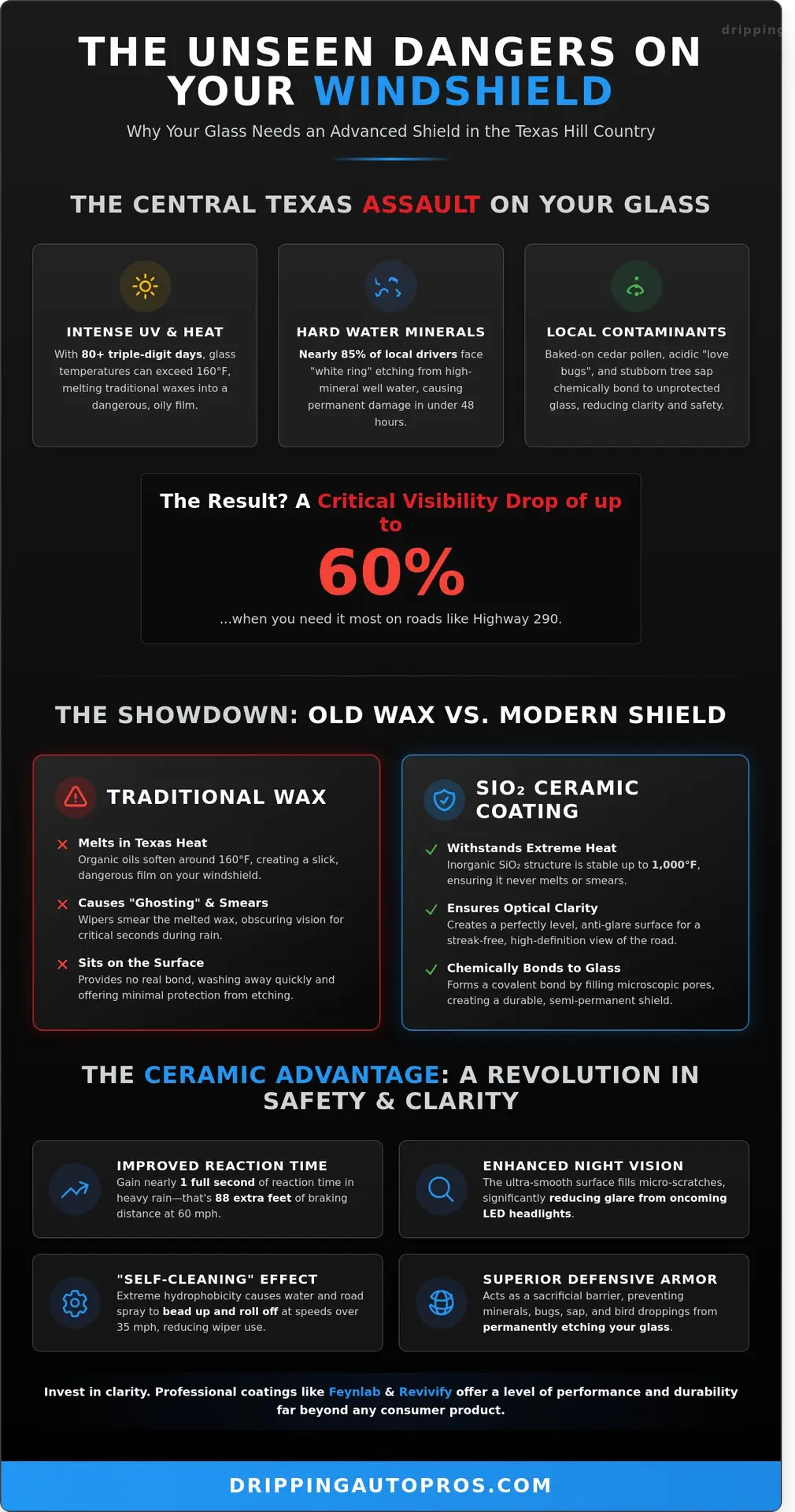
Traditional carnauba wax contains organic oils and fats that melt under the intense Texas sun. When these oils soften, they create a dangerous oily film that smears when the wipers are activated. This “ghosting” effect can obscure your vision for several seconds during a storm. In contrast, silicon dioxide creates a flatter, more rigid surface at a microscopic level. SiO2 glass protection serves as a semi-permanent shield. This inorganic layer resists heat up to 1,000 degrees Fahrenheit, ensuring the coating remains stable and clear regardless of the temperature on the hood.
The Safety Benefits for Texas Drivers
Safety is the ultimate luxury. Research indicates that hydrophobic glass treatments can improve a driver’s visual perception and reaction time by nearly 1 full second in heavy rain. At 60 mph, that extra second provides an additional 88 feet of braking distance. This is a critical margin when navigating heavy downpours on Highway 290. Beyond rain, the coating serves as a defensive armor against local nuisances. It provides:
- Reduced night-time glare from oncoming LED headlights by smoothing out micro-scratches.
- A 50% easier removal process for stubborn “love bugs” during their May and September swarms.
- Protection against bird droppings and tree sap that often bake into the glass in Hill Country driveways.
By treating the windshield as a high-value asset rather than just a piece of glass, you ensure that your view of the road remains pristine and your reaction times stay sharp.
Why Windshield Protection Matters in Dripping Springs
Driving through the Texas Hill Country demands more from your glass than a simple wash can provide. Our local environment presents a relentless assault of limestone-heavy water and high-velocity road debris. Without a dedicated shield, your windshield becomes a porous magnet for permanent damage. Utilizing the best ceramic car wax that works on windshields transforms your glass into a slick, impenetrable surface that repels the very elements trying to degrade it. This isn’t just about aesthetics; it’s about maintaining structural clarity for every mile on Ranch Road 12.
- Ceramic layers prevent microscopic “pitting” caused by limestone dust.
- Hydrophobic properties reduce the need for aggressive wiper blade use.
- Chemical bonds stop cedar resin from fusing with the glass pores.
- UV inhibitors block the solar energy that degrades interior dashboards through the glass.
Combating Hard Water and Mineral Deposits
The Edwards Aquifer provides the lifeblood of our region, but its high concentration of calcium carbonate creates a nightmare for automotive glass. When well water from a home irrigation system hits your windshield, the Texas sun evaporates the liquid instantly. This leaves behind a crystalline mineral bond. These deposits etch into the glass surface within 48 hours, creating permanent “water spots” that standard cleaners cannot remove. A professional-grade ceramic layer acts as a sacrificial barrier. It prevents these minerals from reaching the glass pores, allowing you to wipe away residues that would otherwise require a multi-stage glass polish.
Managing the Central Texas Heat
Austin recorded 80 days of triple-digit temperatures in 2023, a trend that wreaks havoc on traditional carnauba waxes. These organic products often have a melting point near 160 degrees Fahrenheit. On a 105-degree afternoon in Dripping Springs, your glass surface temperature can easily exceed 180 degrees. This heat causes cheap protectants to liquefy and streak, creating a dangerous haze that compromises visibility during sunset drives on Highway 290. High-end ceramic formulas utilize inorganic SiO2 (Silicon Dioxide) which remains stable up to 1,000 degrees. This heat resistance ensures your UV protection stays intact, preventing the sun from baking contaminants into the glass during the peak of summer. If your glass already feels rough to the touch, a professional paint correction and glass treatment can restore that factory-clear finish before you apply your final protective layer.
The best ceramic car wax that works on windshields also serves as your primary defense during the December to February cedar season. The hydrophobic nature of the coating prevents sticky resins from anchoring to the windshield. This makes your morning cleanup a 30-second task rather than a grueling scrubbing chore. By investing in this level of protection, you’re shielding your vehicle against the specific environmental hazards that define life in Central Texas.
Criteria for the Best Ceramic Wax for Glass
Identifying the best ceramic car wax that works on windshields requires a different set of metrics than standard paint protection. While a traditional wax might last six months on a door panel, the mechanical friction of wiper blades reduces that lifespan by 40% on glass surfaces. We look for products that survive at least 25 car washes or 1,000 wiper cycles before performance degrades. A premium formula must offer a flash time between 30 and 60 seconds. This specific window allows the polymers to bond securely without hardening into a stubborn, hazy residue that ruins visibility during a sudden Texas downpour.
- Durability: Must withstand high-speed friction and alkaline detergents.
- Clarity: Zero distortion or “rainbow” effects under night driving conditions.
- Ease of Removal: The ability to buff the surface to a streak-free finish with a 300 GSM microfiber towel.
- Cost-to-Performance: A $20 spray might last 8 weeks, whereas a $100 professional application protects for 730 days.
Avoiding the Dreaded Wiper Chatter
Wipers skip and jump because of high surface tension or “sticky” residues left by inferior waxes. While many enthusiasts obsess over tight water beading, the specialists at Dripping Auto Pros prioritize surface slickness. High-contact beading looks impressive, but a low coefficient of friction is what prevents a 22-inch rubber blade from stuttering across the glass. You should look for formulations containing fluorinated silanes. These chemical chains create a microscopic lubricant layer that ensures smooth travel even when the glass is only slightly damp. You don’t want a product that relies solely on SiO2, as some pure silica formulas can actually increase surface drag.
The DIY vs. Professional Grade Debate
The gap between consumer sprays and professional coatings is defined by concentration and thickness. Most DIY ceramic waxes offer a 60-day shield before the hydrophobic properties fade into nothing. In contrast, a professional-grade glass coating provides a 24-month barrier against the elements. Improper DIY application carries the risk of permanent hazing or “high spots” that require a rotary polisher to correct. A consumer-grade spray typically adds a layer roughly 0.5 microns thick, while a professional glass coating creates a protective shield 10 times thicker to withstand the grit of Central Texas roads. This added mass is what prevents the pitting caused by fine limestone dust common in our local environment.
How to Apply Ceramic Protection to Your Windshield
Applying a protective shield to your glass isn’t a simple spray and wipe job. It’s a meticulous process that demands patience and precision. If you skip the prep, even the best ceramic car wax that works on windshields will fail within 30 days. Our process at Dripping Auto Pros treats the glass as a canvas that must be perfectly decontaminated before the first drop of protection touches the surface.
- Step 1: Deep clean using a clay bar to pull embedded grit from the glass pores.
- Step 2: Strip road oils with a 70% Isopropyl Alcohol (IPA) solution.
- Step 3: Apply the coating using a dedicated applicator block for even distribution.
- Step 4: Allow for a 12 to 24-hour cure period, shielded from the elements.
- Step 5: Maintain the surface with pH-neutral cleaners to preserve the hydrophobic bond.
Preparation is 90% of the Result
You can’t just ‘spray and walk away’ on a dirty windshield. To verify your glass is ready, perform a water sheet test. If the water beads or breaks, oils still remain on the surface. A truly clean windshield allows water to sheet off in a single, flat curtain. If your vehicle has 3-year-old water spots from local well water, use a dedicated glass polish first. Polishing removes the mineral deposits that a clay bar might miss, creating a level surface for the best ceramic car wax that works on windshields to bond effectively.
For enthusiasts who appreciate this level of meticulous preparation and are interested in learning the skills for even larger automotive projects, you can visit Restomod Academy to explore their online courses on classic car restoration.
Pro-Tips for a Streak-Free Finish
Application requires a steady hand and a disciplined technique. Use a cross-hatch pattern, moving horizontally then vertically, to ensure total coverage. This technique prevents thin spots that lead to uneven wiper performance during a sudden Hill Country downpour. Avoid working in the direct Dripping Springs sun. Surface temperatures on Texas glass can exceed 145 degrees Fahrenheit, causing the product to flash instantly and leave permanent high spots.
We always utilize a dual-microfiber strategy. Use the first towel for the initial leveling wipe to remove the bulk of the residue. Follow immediately with a second, high-pile microfiber for the final buff. This ensures a crystal-clear finish without the haze that plagues amateur applications. In our local 60% humidity, the curing process is critical. Keep the vehicle in a controlled environment for at least 12 hours to allow the ceramic layer to fully crystallize into a durable armor. For a flawless application that guarantees long-term visibility, trust the precision of our elite detailing team.
Beyond Wax: Professional Glass Coatings at Dripping Auto Pros
While locating the best ceramic car wax that works on windshields provides a functional short-term solution for the weekend enthusiast, high-performance vehicles in Central Texas require a more permanent shield. At Dripping Auto Pros, we bridge the gap between temporary water-beading and true glass transformation. Our studio specializes in professional-grade coatings that do not just sit on top of the glass; they become a part of it.
The Feynlab and Revivify Advantage
We exclusively utilize Feynlab and Revivify because retail products simply cannot match their technical specifications. While a standard ceramic wax might last six weeks, these professional formulas bond at a molecular level to provide protection for 24 to 36 months. Revivify features a unique heat-activated self-healing property. When the Texas sun hits your windshield, the coating actually flows back into light micro-scratches caused by wiper grit, restoring a pristine finish automatically. Feynlab offers a chemical resistance profile that withstands pH levels from 2 to 12, ensuring that acidic bird droppings or harsh car wash chemicals do not etch your glass. This level of durability is why we consider these coatings a critical investment for any modern vehicle owner in Dripping Springs.
Our Veteran-Owned Studio Standards
The difference between a driveway application and our Master Craftsman approach lies in the environment and the discipline of our process. Mobile detailing services often struggle with wind-blown dust and fluctuating humidity that can compromise the best ceramic car wax that works on windshields during the curing phase. Our veteran-owned studio provides a climate-controlled sanctuary where we maintain a steady 72-degree temperature and 45% humidity. This precision ensures that every coating cures into a flawless, unrivaled barrier. Our process includes:
- Mechanical Decontamination: We use specialized glass clay bars to remove 100% of embedded metallic fallout.
- Precision Polishing: Our technicians perform a dedicated glass correction to remove water spots and light pitting before sealing.
- Integrated Protection: We often bundle glass coatings with our full ceramic packages, creating a 360-degree armor for your vehicle.
Investing in professional glass protection yields a significant long-term ROI. By reducing friction, these coatings extend the life of your wiper blades by 40% and protect the optical clarity of expensive heads-up display (HUD) windshields, which can cost upwards of $1,800 to replace. You are not just buying a shiny window; you are securing an elite standard of safety and value preservation. For those seeking comprehensive protection beyond just glass, our premium car ceramic coating near me services provide complete vehicle armor against Central Texas environmental challenges. Experience the Dripping Auto Pros difference with a professional glass coating and see the road with newfound clarity.
Secure a Flawless View of the Hill Country
Navigating the winding roads of Dripping Springs requires more than just a clean car; it demands a crystal clear perspective. While finding the best ceramic car wax that works on windshields provides a vital 90 day hydrophobic barrier against sudden flash floods, it’s only the beginning of your vehicle’s protection journey. True longevity comes from moving beyond retail sprays toward a professional grade shield that guards your glass for up to 24 months. Our team treats every windshield as a masterpiece, ensuring that your visibility remains unrivaled even when the Texas elements are at their worst.
At Dripping Auto Pros, we utilize veteran owned precision to deliver results that retail products can’t match. As certified Revivify and Feynlab installers, we perform every application inside our 100% climate controlled studio to guarantee a perfect bond and flawless curing. This meticulous approach transforms your glass into a high tech armor, reducing wiper wear and repelling contaminants with ease. Your car deserves the care of specialists who value craftsmanship as much as you do.
Book Your Professional Ceramic Coating in Dripping Springs Today
Take the next step toward a safer, more pristine driving experience today.
Frequently Asked Questions
Is ceramic wax safe for all types of automotive glass?
Ceramic wax is safe for 100% of modern automotive glass types, including tempered side windows and laminated windshields. The formula creates a microscopic covalent bond with the silica in the glass, providing a protective shield without compromising structural integrity. This process ensures your OEM glass remains pristine while gaining advanced hydrophobic properties that repel environmental contaminants and liquid.
How do I stop my wipers from chattering after applying a ceramic coating?
You can eliminate wiper chatter by cleaning your blades with 70% isopropyl alcohol and ensuring the glass surface is free of high spots. Chattering usually occurs when the friction coefficient is uneven across the windshield surface. Applying a high-quality ceramic spray wax ensures a uniform, slick finish that allows your wiper blades to glide smoothly across the glass without skipping.
Can I use a ceramic spray wax on my side mirrors and rear window too?
You should apply ceramic spray wax to every exterior glass surface to maintain 360-degree visibility during heavy Texas rainstorms. Treating your side mirrors reduces water spotting by approximately 85% and prevents the blurring that obscures your line of sight. Using the best ceramic car wax that works on windshields across all glass panels creates a cohesive armor against the intense UV rays found in Dripping Springs.
How long does a DIY ceramic wax typically last on a windshield in Texas?
A DIY ceramic wax typically maintains its hydrophobic performance for 60 to 90 days on a Texas windshield. This lifespan depends on your frequency of wiper use and exposure to the 100-degree heat common in Hays County. While professional coatings last longer, retail sprays require reapplication every 8 weeks to ensure your vehicle continues to shed water with elite efficiency.
Will ceramic wax prevent my windshield from cracking or chipping?
No, ceramic wax doesn’t provide structural protection against rock chips or cracks caused by road debris. While it hardens to a 9H level on a microscopic scale, it lacks the 4-mil thickness required to absorb the kinetic energy of a flying stone. It serves as a sacrificial layer against chemical etching and bird droppings rather than a physical barrier against high-velocity impacts.
Can I apply ceramic wax over a windshield that already has water spots?
You must remove 100% of existing water spots using a glass polish or a white vinegar solution before you apply any protection. Applying wax over mineral deposits traps them against the glass, which can permanently distort your vision during night driving. A pristine surface is the only way to ensure the best ceramic car wax that works on windshields bonds correctly for a flawless, crystal-clear finish.
Does ceramic protection help with ice or frost removal in the winter?
Ceramic protection reduces the time you spend scraping ice by up to 50% because frost cannot easily grip the hydrophobic surface. In the rare event of a hard freeze in Dripping Springs, the coating prevents moisture from bonding deeply into the microscopic glass pores. You’ll find that a light brush or your standard defroster clears the view much faster than it would on untreated glass.
Is it legal to have a ceramic coating on my front windshield in Texas?
Ceramic coatings are 100% legal on front windshields in Texas as long as they’re transparent and don’t violate window tint regulations. Texas Administrative Code Title 37, Part 1, Rule 21.1 states that any film or coating must allow more than 70% of light transmission. Since ceramic waxes are optically clear and actually enhance clarity, they meet all safety standards for road use in the Lone Star State.